

Why Every PR Team Needs Media Analytics Services | Ryans
Ask most PR managers how their last campaign performed, and you'll usually get a number: 40 articles, 12 million impressions, coverage in three national outlets. It sounds impressive in a meeting. It rarely survives the next question — "So what did that actually do for us?"
That gap between activity and outcome is the reason media analytics services exist. A stack of press clippings tells you that coverage happened. It doesn't tell you whether the coverage shifted reputation, whether the tone was actually favorable, whether a competitor quietly out-messaged you in the same news cycle, or whether a small negative story is about to become a large one. PR reporting, in its traditional form, was built to document. Media analytics was built to explain and predict.
This distinction matters more today than it did five years ago. Communications teams now sit closer to the boardroom, and boardrooms increasingly ask them to justify budgets with data that connects to business outcomes, not just media logs. At the same time, the news cycle has gotten faster and less forgiving. A single unchecked post can travel from a niche forum to national coverage within hours, and by the time a monthly PR report lands on someone's desk, the moment to act on it may already be gone.
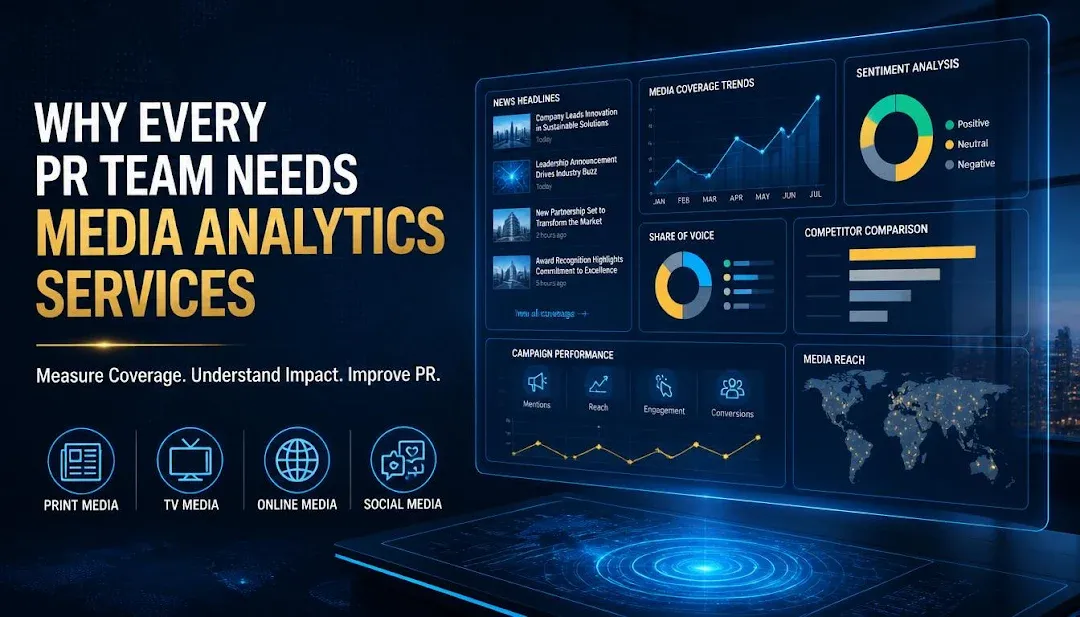
This is where a dedicated media intelligence partner earns its place. Ryans Archives Limited has been tracking print, broadcast, online, and social media coverage for over 26 years, working with banks, telecoms, NGOs, and multinational companies across Bangladesh and beyond. This article looks at what media analytics actually is, how it differs from conventional PR reporting, and why organizations from listed companies to government bodies are treating it as core infrastructure rather than a nice-to-have.
What Media Analytics Actually Means (And How It Differs from Basic PR Reporting)
The terms media monitoring, PR reporting, and media analytics get used interchangeably, but they describe three different stages of the same process — and confusing them is where a lot of PR measurement goes wrong.
Media monitoring is the collection layer. It's the practice of tracking where your organization, executives, products, or competitors are mentioned across print, broadcast, online news, and social platforms. Ryans Archives' News Coverage & Insights service handles this layer directly, tracking daily coverage across all five major channels.
PR reporting is the presentation layer. It takes what monitoring picked up and turns it into a document — usually a weekly or monthly summary listing the number of mentions, a few headline placements, and maybe a reach estimate. It answers "what happened," but rarely "what it meant" or "what to do next."
Media analytics is the interpretation layer, and it's the piece most organizations underinvest in. It takes the same raw coverage and asks harder questions of it: What is the actual sentiment behind each mention, not just whether the brand was named? How does share of voice compare to named competitors over time? Which spokespeople or messages are gaining traction with journalists and audiences, and which are being ignored? Is a cluster of negative stories forming a pattern that signals emerging reputational risk?
Media Monitoring vs. Media Analytics vs. PR Reporting
Monitoring gathers the data, reporting displays it, and analytics explains what it means and what should happen next. An organization that only monitors and reports is working from a dashboard full of gauges with no one reading them. Media analytics is the read.
The Shift from Counting Mentions to Measuring Impact
The bigger shift underway in the industry is a move away from output metrics — mention counts, impressions, clip counts — toward outcome metrics: sentiment trajectory, message adoption, share of voice, and correlation between coverage and business indicators like website traffic or customer inquiries. Global measurement bodies like AMEC (the International Association for the Measurement and Evaluation of Communication) have pushed this shift for over a decade through the Barcelona Principles, which discourage AVE (Advertising Value Equivalency) as a standalone metric and call for outcome-based measurement instead.
The Problem with Traditional PR Reporting
Most PR teams aren't lacking data. They're drowning in it and still can't answer the questions that matter. A typical monthly report lists mention counts, a handful of standout placements, and a reach figure that gets bigger every quarter almost by default, because more outlets exist now than they did five years ago.
Vanity Metrics That Don't Convince Leadership
Impressions and clip counts are easy to collect and easy to present, which is exactly why they've stuck around so long. But a finance director doesn't care that a brand appeared in 200 articles. They care whether that coverage shifted perception, supported a launch, or protected the company during a difficult quarter.
Missed Risk Signals in Real Time
Traditional reporting is usually retrospective. A weekly or monthly cadence means a negative story can build for days before anyone with authority to respond even sees it in context. This is where real-time capability matters — Ryans Archives pushes priority and crisis-level mentions within minutes of publication or broadcast, rather than waiting for a scheduled report.
The AVE (Advertising Value Equivalency) Debate
For years, PR reporting leaned on AVE — converting earned coverage into a dollar figure based on what the same space would have cost as an ad. It's an appealing shortcut because it produces a single, boardroom-friendly number. The problem is that AVE was never designed to measure PR outcomes; it measures ad space pricing, which has little to do with whether coverage changed anyone's opinion.
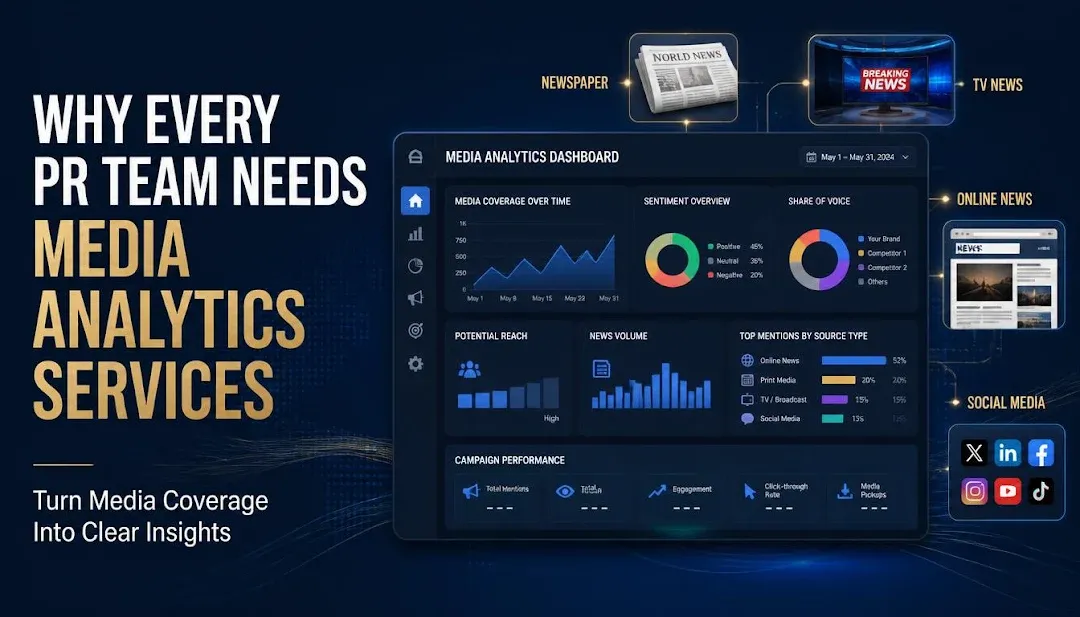
Core Benefits of Media Analytics Services for PR Teams
Proving PR ROI to the C-Suite
Media analytics connects coverage to outcomes: sentiment shifts around a launch, share of voice gained during a competitor's stumble, or measurable movement in branded search after a campaign. Ryans Archives' PR Campaign Performance service is built specifically to measure this — reach, impact, and results against defined KPIs, not just clip counts.
Real-Time Reputation and Crisis Monitoring
Rather than waiting for a scheduled report, a strong media analytics setup flags spikes in negative sentiment or unusual coverage volume as they happen. For crisis management teams, that early warning is often the entire difference between a same-day response and a story that has already dominated the news cycle.
Competitive Benchmarking and Share of Voice
Share of voice — how much of the category conversation belongs to you versus named competitors — is one of the most useful metrics PR reporting on its own rarely captures well. Ryans Archives tracks this consistently across markets and topics, alongside Advertisement Tracking that verifies where and how often competitors are actually airing or placing ads.
Sentiment Analysis Across Languages and Markets
For multinational companies, telecoms, and financial institutions operating across several regions, sentiment doesn't move uniformly. A story that reads as neutral in one market can carry a very different tone once translated and read in another. Ryans Archives monitors Bangla and English natively, with additional languages supported on request, combining AI-assisted scoring with human quality assurance so tone assessments hold up.
Data-Backed Strategy Instead of Guesswork
Media analytics turns PR planning from instinct into evidence. Instead of assuming a certain spokesperson or story angle resonates, teams can see which messages actually pulled through into coverage and plan the next campaign around what's proven to work.
Who Needs Media Analytics Most (Beyond PR Teams)
Regulated Industries: Banks, Telecoms, and Listed Companies
Banks, telecom operators, and publicly listed companies operate under constant scrutiny, where a single misreported figure or misquoted executive can move sentiment or draw regulatory attention. Clients like IFIC Bank PLC and Banglalink already rely on Ryans Archives for exactly this kind of media monitoring — timely, accurate, and consistent enough to feed directly into their compliance and communications functions.
Government, NGOs, and Public-Trust Organizations
Government bodies and NGOs are judged on public trust in a way few private companies are. Ryans Archives has worked with organizations like Brac to make sure media coverage reflects accurate understanding of programs and policy, not just volume of mentions.
Crisis and Risk & Compliance Teams
Crisis teams increasingly rely on media analytics as an early warning system that sits alongside legal and regulatory monitoring. A sudden shift in sentiment or an emerging narrative around a specific executive or product line often surfaces in media data well before it reaches a formal complaint.
Key Metrics a Good Media Analytics Program Should Track
Share of Voice and Message Pull-Through
Whether the specific talking points a PR team pushed actually appeared in the resulting coverage — a stronger signal of message control than mention count alone.
Sentiment and Tone Trends
Tracked as a trend line rather than a single snapshot, revealing whether reputation is genuinely improving, holding steady, or eroding gradually.
Reach, Engagement, and Earned Media Value
Most useful when paired with a credible earned media value model rather than a flat AVE calculation — one that accounts for outlet authority, placement prominence, and audience relevance.
Spokesperson and Executive Visibility
Tracking which executives are being quoted, how often, and in what tone helps organizations understand whether leadership is building credibility in the media or becoming a liability in interviews.
How to Choose a Media Analytics Partner or Tool
Coverage Breadth (Print, Broadcast, Online, Social)
A partner that only monitors online news will miss broadcast and print coverage that still carries significant weight in many markets. Ryans Archives covers newspapers and magazines, news portals and blogs, TV news and talk shows, radio broadcasts, and platforms including Facebook, X, YouTube, LinkedIn, and TikTok.
Human Analysis vs. Pure AI Sentiment Scoring
Automated sentiment tools are fast but frequently misread sarcasm, mixed coverage, or culturally specific phrasing. Ryans Archives pairs AI classification with human QA on every deliverable, particularly important for Bangla-English media where nuance matters.
Custom Dashboards and Reporting Cadence
The right partner should let a PR team set its own reporting rhythm. Ryans Archives delivers reports in PDF, PowerPoint, Excel, Word, Google Sheets, Google Docs, or live dashboards, on hourly, daily, or weekly cadence, depending on how sensitive the topic is.
Building a PR Reporting Framework That Leadership Actually Trusts
Aligning Metrics with Business Objectives
The most trusted PR reporting frameworks start from business goals, not media outputs. If the objective is investor confidence, the metrics should tie to sentiment among financial media — not generic impression totals.
The Barcelona Principles as a Measurement Standard
Adopting a recognized framework like AMEC's Barcelona Principles gives PR reporting external credibility. It signals to leadership that the measurement approach follows an industry-accepted standard for connecting communications activity to real outcomes, and it's the standard Ryans Archives builds its own reporting methodology around.
Where This Leaves Your PR Team
PR reporting was never the problem — it's simply incomplete on its own. Media analytics is what turns a stack of clippings into a decision-making tool: proving ROI to leadership, catching reputational risk before it escalates, and giving PR teams the same kind of data-backed credibility that finance, sales, and marketing have had for years.
For organizations operating under real scrutiny — banks, telecoms, listed companies, government bodies, and anyone managing crisis-level stakes — media analytics services aren't a luxury add-on to the comms function. They're the baseline for doing PR responsibly in a media environment that moves faster than a monthly report can keep up with.
Ryans Archives Limited has spent 26+ years building exactly this kind of infrastructure for 500+ clients worldwide, from Brac and Chevron Bangladesh to Walton Hi-Tech Industries. If your PR reporting is still built around clip counts, it might be time to see what a proper media analytics setup looks like. Request a demo or explore the full range of services.
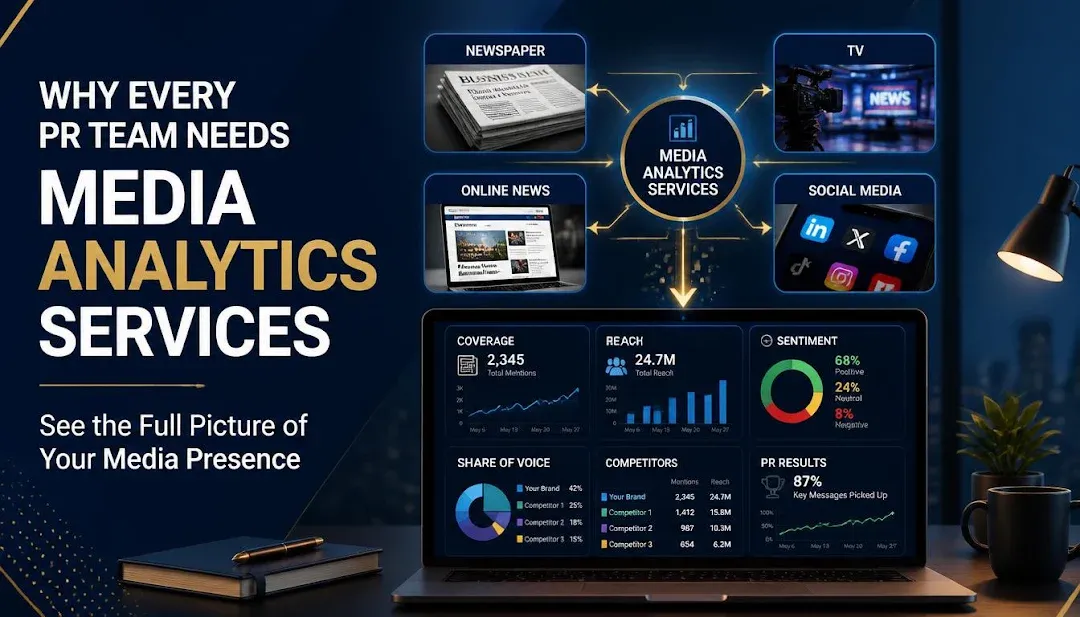
FAQ
What is the difference between media monitoring and media analytics?
Media monitoring collects mentions of your brand across news and social channels. Media analytics interprets that data — sentiment, share of voice, message pull-through — to explain what the coverage actually means and what to do about it.
How is PR ROI measured?
PR ROI is best measured by connecting coverage to business outcomes: sentiment shifts, share of voice against competitors, referral traffic, and correlation with metrics like sales inquiries or investor sentiment, rather than relying on impressions or AVE alone.
What is AVE and is it still used?
Advertising Value Equivalency (AVE) converts earned coverage into an equivalent ad-spend dollar figure. It's still used in some reports because it's simple, but measurement bodies like AMEC discourage it as a standalone metric since it doesn't reflect actual impact.
How often should PR reporting be done?
Cadence should match risk level: real-time alerts for crisis-sensitive organizations, weekly or biweekly dashboards for active campaigns, and monthly or quarterly summaries for broader executive reporting.