

24/7 Media Monitoring for Enterprises | Ryans
A news story does not wait for your office to open. A customer can post a complaint at 11 p.m., a page can share it by midnight, and a reporter can pick it up before Fajr. When your team logs in at 9 a.m., the story already has a shape, and it may not be the one you wanted.
That is why more organisations now treat 24/7 media monitoring as a core part of their communication work. It means watching print, TV, radio, online news and social media around the clock, so nothing important about your brand slips past you.
This guide explains what round-the-clock monitoring is, why business hours are no longer enough, who needs it most, and how to set up enterprise monitoring that your team will actually use. We will also show how Ryans Archives Limited does this for organisations in Bangladesh and abroad.
What Is 24/7 Media Monitoring?
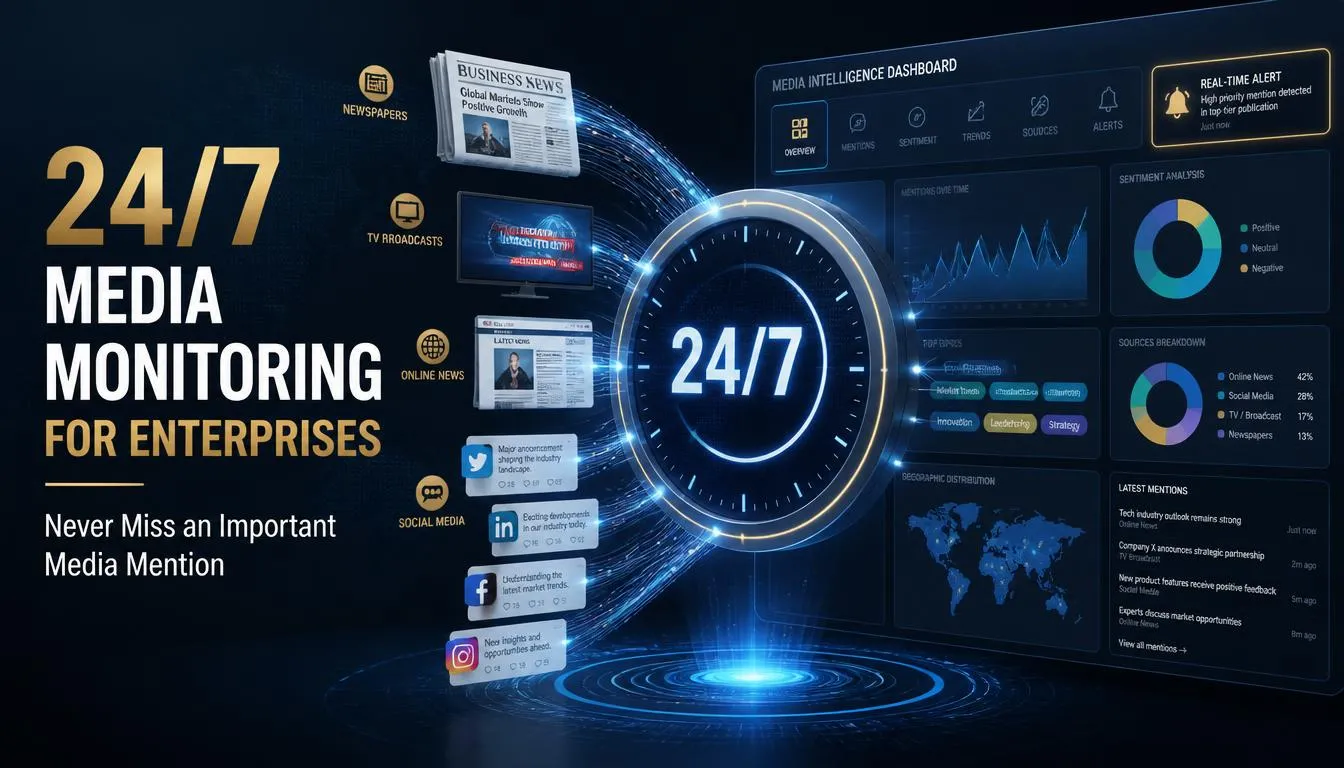
24/7 media monitoring is the continuous tracking of mentions about your organisation, your leaders, your products, your competitors and your industry. It runs every day of the year, including weekends and public holidays.
Good monitoring uses both software and people. Software scans huge numbers of sources fast. Trained analysts then check what it finds, remove the noise, and decide which items need attention. Neither works well alone. Software misses context, and people cannot read everything by hand.
What It Covers
A complete service tracks:
- Print: newspapers and magazines
- Online: news portals and blogs
- TV: news bulletins and talk shows
- Radio: broadcasts and news segments
- Social media: Facebook, X, YouTube, LinkedIn, TikTok and more
The aim is not to collect every mention. The aim is to find the few that matter and put them in front of the right person quickly.
How It Differs From Daily News Clipping
Many teams still rely on a morning news summary. Someone collects yesterday's coverage, puts it in a file and emails it around. That is useful, and it has a place. But it looks backward. It tells you what already happened.
Round-the-clock monitoring looks forward. It sends an alert while a story is still small, so you can respond before it grows. A morning report can tell you about a crisis. A live alert can help you stop one.
Why Business Hours Are Not Enough
Most monitoring setups run on office time. The public does not.
Think about how a story moves today. A video is posted in the evening. A few hundred people share it. By night it has thousands of views. An online portal writes it up, and the next morning's TV shows bring it up. You are the last to know, and you are now answering a story that other people have already told for you.
Three things make office-hour monitoring risky:
1. Speed. Social media can spread a rumour in hours. The first few hours of a story often decide how people remember it.
2. Time zones. If you deal with partners, investors or customers abroad, your night is someone else's working day. Multinational companies are always live somewhere.
3. The cost of silence. When a brand says nothing for half a day, people fill the gap with guesses. Guesses are hard to correct later.
A calm, factual reply in the first hour costs far less than a long recovery campaign. But you can only reply fast if you know the story exists.
Key Benefits of 24/7 Media Monitoring
Catch a Crisis Before It Spreads
This is the biggest benefit. Most crises start small: one post, one complaint, one unchecked claim. Live alerts let your crisis team see it early and answer while the story is still manageable.
Picture a telecom company. Late at night, a network problem begins in one city. Customers start posting screenshots. With monitoring on, the duty officer gets an alert within minutes and a short public update goes out before the first news portal writes about it. The outage still happened, but the company looks organised and honest. That difference protects trust.
Protect Your Brand Reputation
Reputation builds slowly and can fall fast. Monitoring shows you not only how often people mention you, but how they talk about you. Sentiment analysis marks mentions as positive, neutral or negative, which helps you spot a shift in tone early. It is not perfect on its own, so human review matters.
You can also find false stories, fake press notes, wrong quotes and edited images. Catching misinformation early lets you correct it with facts before it settles in people's minds.
Track Competitors and Market Shifts
Monitoring is not only defence. When you follow your competitors' coverage, you learn what they announce, where they get criticised and which messages work for them.
Comparing your share of voice, meaning your slice of the total conversation against theirs, helps marketing teams decide where to put their effort and budget.
Support Risk and Compliance Work
For banks and other regulated bodies, public news is part of risk management. A regulator's warning, a court case, a data leak or a supplier problem can hit your business quickly.
Risk and compliance teams use monitoring to:
- Spot early signs of legal or regulatory trouble
- Watch partners, vendors and clients for negative news
- Keep a dated record of coverage for audits and board reports
A dated record also protects you. If someone asks when you first knew about an issue, you have timestamps.
Prove the Value of PR and Communications
Communication teams are often asked, "What did all this achieve?" Monitoring gives real answers. You can show how many articles covered a campaign, what the tone was, which outlets ran it and how coverage changed after an event.
With clear data, your PR budget is easier to defend and your next plan is easier to write.
Who Needs Round-the-Clock Monitoring?
Any organisation with a public reputation can benefit. Some face higher risk than others.
Banks and Financial Institutions
Trust is the product. A false rumour about a bank can cause panic even when it has no basis. Financial firms need to see such stories at once and answer with facts. They also follow news on fraud, data breaches and regulatory changes.
Telecom Companies
Telecom brands serve huge customer bases and get frequent complaints about service, billing and data. Problems go viral quickly. Live monitoring lets them respond in the same place the complaint started.
Government Organisations and NGOs
Public bodies need to know how policies and projects are received. NGOs and development organisations depend on donor and community trust, and a misleading story can hurt funding and field work. Monitoring helps both track public opinion, correct errors and report on their impact.
Listed Companies and Multinationals
For listed companies, news can move the share price, and investors, analysts and regulators read the same headlines you do. Multinationals also face different media in each country, in different languages, on different schedules. Continuous tracking is the only practical way to keep up.
FMCG and Consumer Brands
Product complaints, recalls and ad campaigns all play out in public. Consumer brands need to see how people react to a launch and whether their ads ran as promised.
What Should You Monitor?
Start with a clear list. Too many keywords create noise. Too few create blind spots. A good starting list includes:
- Your brand name and its spelling variations, including short forms and Bangla spellings
- Product and service names
- Executives and spokespeople
- Competitors
- Industry topics, such as new rules or market trends
- Risk words such as "recall," "lawsuit," "outage," "fraud" or "boycott" next to your name
Language matters too. In Bangladesh, a large share of the conversation happens in Bangla, and a tool that reads only English will miss it. Your monitoring should cover every language your audience uses.
What Good Enterprise Monitoring Looks Like
Enterprise monitoring is more than a search alert on one person's laptop. It is a shared system that connects people, tools and decisions across the organisation. A strong setup has these parts.
A clear alert plan. Decide who gets which alert. A minor mention can go into a daily digest. A serious negative story should reach the crisis lead immediately. Define what "serious" means before you need it.
Human review. Software reads fast but can misread sarcasm, slang and local context. Trained analysts filter false alarms and add context, so your team gets useful alerts instead of a flood.
Wide source coverage. A story often starts in one channel and jumps to another. Print, TV, radio, online and social all need to be included.
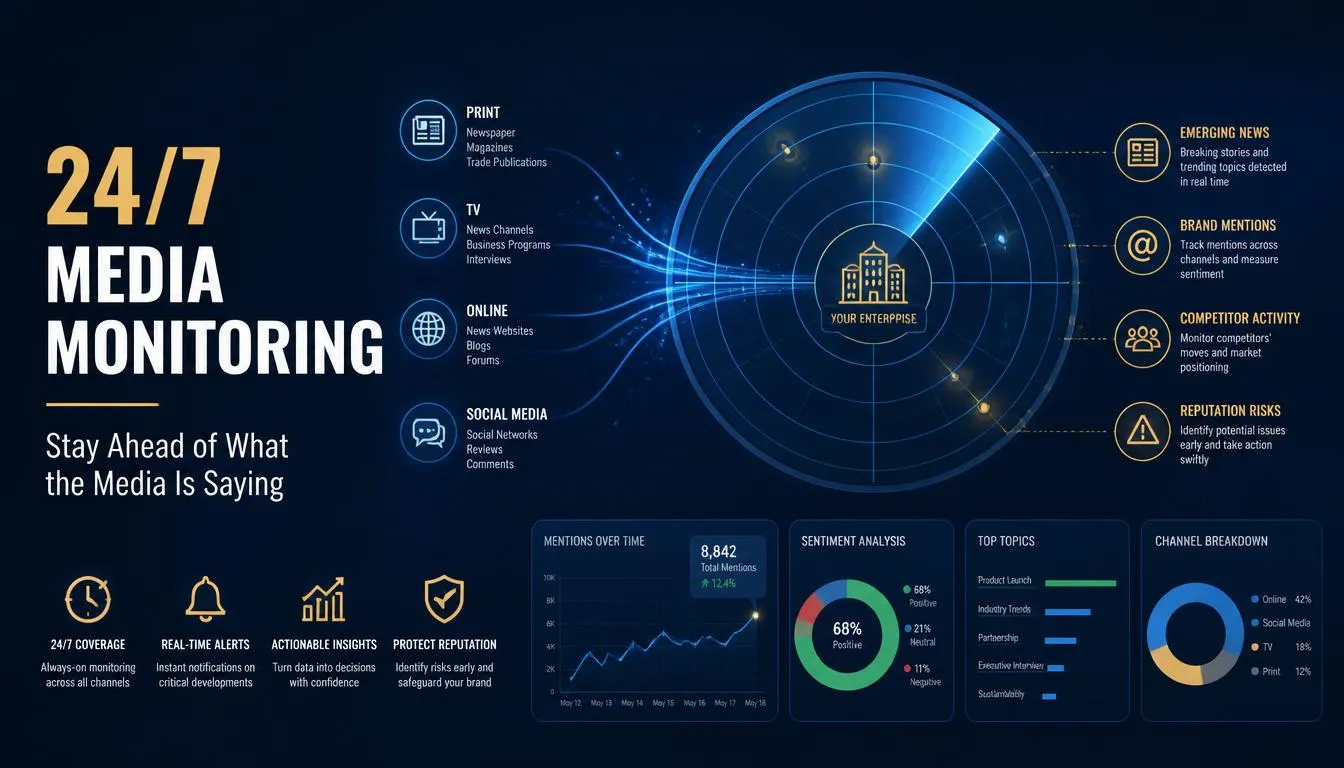
Dashboards and regular reports. Leaders need a quick view, not a long document. A good dashboard shows volume, sentiment, top sources and trending topics at a glance.
Escalation steps. When a crisis alert arrives, everyone should know who decides, who writes the response, who approves it and who talks to the press. Practise this once or twice a year.
Security. Your monitoring data is sensitive. Ask how it is stored and who can access it.
How Ryans Archives Delivers 24/7 Media Monitoring
Ryans Archives Limited has provided media intelligence since 2000. That is more than 26 years of watching, reading and analysing the news. Our team captures and analyses coverage across print, online, TV, radio and social media, and combines AI-assisted analysis with human quality checks on every deliverable.
Here is how the service works in practice.
Real-Time Alerts for What Matters
Priority and crisis-level mentions are pushed to you in near real time, typically within minutes of publication or broadcast. Routine coverage arrives on the schedule you choose: hourly, daily or weekly. You decide what counts as urgent, and we build the rules around that.
Our News Coverage & Insights service tracks print, broadcast and online news across Bangladesh and turns it into clear briefs, so your team reads insight and not a pile of links.
Social Media Listening
Conversations that start on social media often become tomorrow's headlines. Our Social Media Listening service follows brand, competitor and industry conversations across the major platforms, so you see the spark before the fire.
Bangla and English, Natively
We monitor Bangla and English natively and support other languages on request. Coverage is translated where needed and normalised, so your analytics stay consistent across languages. Our Synopsis, Translation & Transcription service helps teams that need summaries or transcripts of TV and radio content.
Sentiment and Competitor Benchmarking
Every mention is scored for tone using a mix of AI classification and human review. We also benchmark share of voice, tone and topics against the competitors you name during onboarding.
PR and Ad Measurement
Monitoring should prove value, not just collect clippings. Our PR Campaign Performance service measures the real reach and impact of campaigns against your KPIs. Our Advertisement Tracking service checks ad placements across TV, print and digital, so you can confirm your ads aired as planned.
Reports in Your Format
Your team already has a way of working, and we adapt to it. Reports come as email alerts, Excel, Google Sheets, Word, Google Docs, PDF, PowerPoint, Google Slides, live dashboards and more. You choose the format and the schedule.
A Long Memory
News that matters today may matter again in five years. Our Historical Data & Digital Archiving service builds searchable archives of media and organisational records, built for fast retrieval.
Who We Work With
Organisations across banking, telecom, energy, development, electronics and government use our services. Clients who have shared reviews on our website include Chevron Bangladesh, Banglalink, IFIC Bank, BRAC, Singer Bangladesh and Walton Hi-Tech Industries. Our work also reaches clients in countries such as Nepal, Bhutan, Malaysia, Singapore, Japan and the UK.
Getting Started Is Simple
We keep the process short:
- Consult: we learn your brand, KPIs and reporting rhythm.
- Monitor: we capture coverage across print, broadcast, digital and social.
- Analyse: we score sentiment, benchmark competitors and flag signals.
- Report: we deliver briefs and dashboards on schedule.
You share your brand name, competitor list, target markets and preferred schedule. We reply within one business day with a scoped proposal, and most clients start receiving reports within about a week.
Talk to our team about 24/7 media monitoring
How to Choose a Monitoring Provider
Whoever you pick, ask these questions. Vendors' promises sound alike, and the answers show the difference.
- Is it truly 24/7, and who is watching at night? Ask whether real analysts work overnight.
- Which sources and languages are covered? Ask for a sample list, especially for your country.
- How fast are alerts? Ask for typical delays, not the best case.
- How accurate is the filtering? Test it with your own keywords during a trial.
- Can reports be customised? Your board, PR team and compliance team need different views.
- Is there human support? In an emergency you want a person to call, not a ticket number.
- How long have they been doing this? Experience shows in how well they handle local media.
- Can they show real examples? Ask for sample reports and references from similar organisations.
Ask for a demo and judge it using a real topic from your own business.
Common Mistakes to Avoid
Watching only your brand name. Problems often start with a topic, a supplier or a person connected to you.
Setting alerts and forgetting them. Your business changes, so your keywords should too. Review them every quarter.
Too many alerts. If everything is urgent, nothing is. Rank alerts by importance.
No response plan. Seeing a problem at 3 a.m. helps only if someone knows what to do.
Ignoring good coverage. Positive news shows which messages work and gives you stories to share.
Treating sentiment scores as final. Use them as a guide, then read the actual content.
How to Get Started in 30 Days
You do not need a huge project. Here is a simple plan.
Week 1: Set your goals. Decide what you want to protect or learn: reputation, crisis readiness, competitor insight or compliance. List the top five risks to your brand.
Week 2: Build your keyword and source list. Write down brand names, people, products, competitors and risk words in every language your audience uses.
Week 3: Create your alert and response plan. Decide who receives what and through which channel. Write a one-page escalation guide.
Week 4: Run a test. Use a mock scenario, such as a service outage or a false rumour, and see how fast your team responds. Fix the gaps, then go live.
After launch, review results every month and update your settings.
FAQs
What does 24/7 media monitoring mean?
It means tracking news, social media and other public sources about your organisation all day and night, including weekends and holidays, so you can react quickly to important stories.
How is enterprise monitoring different from a basic alert tool?
Basic tools send keyword alerts to one person. Enterprise monitoring covers more sources and languages, adds human review, and includes dashboards, reports and clear escalation rules across teams.
Which media channels does Ryans Archives monitor?
We cover print, online news, TV, radio and social media, including Facebook, X, YouTube, LinkedIn and TikTok, for Bangladesh and selected international markets.
How fast will I get alerts?
Priority and crisis-level mentions are pushed in near real time, typically within minutes of publication or broadcast. Other coverage arrives hourly, daily or weekly, depending on your plan.
Can you monitor Bangla content?
Yes. We monitor Bangla and English natively and support more languages on request.
Is 24/7 monitoring only for large companies?
No. Large enterprises need it most, but any organisation with a public reputation can benefit, from a growing brand to an NGO.
Can monitoring stop a crisis completely?
Not always. Some events cannot be prevented. But early awareness helps you respond faster and more clearly, which limits the damage.
How do I start?
Send us your brand name, competitor list, target markets and reporting schedule through our contact page. You can also call +88 01755 513 979 or email archives@ryans.com.
Conclusion
The news never sleeps, and neither do rumours. Organisations that wait until morning to learn what happened overnight are always one step behind. 24/7 media monitoring closes that gap. It gives you early warning, a clearer view of your reputation, better insight into competitors and solid proof of your communication work.
The approach is simple. Know what you want to protect, choose your keywords and sources with care, set clear alert rules, and make sure someone is ready to act. Combine fast technology with people who understand local context, and you have a system you can trust.
Ryans Archives has done this for more than 26 years. If you want to see what people are saying about your organisation right now, request a demo and we will show you.
Written by [Author Name], [Job Title] at Ryans Archives Limited. Last updated: [Date].