

Newspaper Monitoring vs Online News Monitoring: Which One Does Your Organisation Need?
Ask ten communication managers whether they still need newspaper monitoring services, and you will get ten different answers. Some say print is fading. Others say their board still reads the papers over breakfast and judges the company by what it finds there. Both groups are partly right.
The real question is not which channel is better. It is which one tells you what you need to know, and when you need to know it. This guide compares newspaper monitoring and online news monitoring side by side. We will look at how each one works, where each is strong, where each falls short, and how to decide what your organisation needs.
We will also show how Ryans Archives Limited handles both for clients in Bangladesh and abroad.
What Is Newspaper Monitoring?
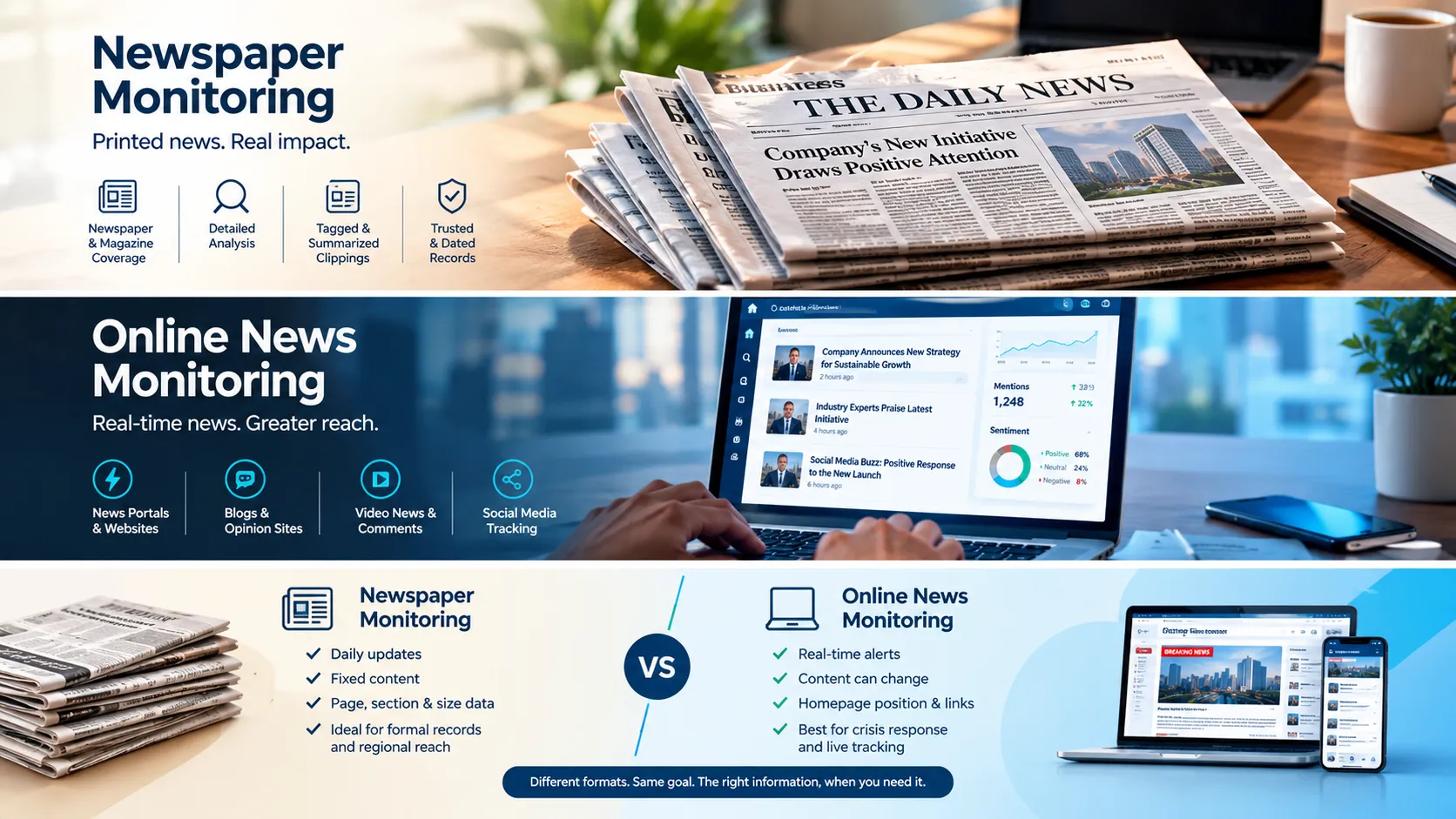
Newspaper monitoring means reading printed newspapers and magazines every day, finding the stories that mention your organisation, your leaders, your products, your competitors or your industry, and sending them to you in a form you can use. That form is usually a clipping: a scanned image of the article with the paper's name, the date and the page number attached.
A good provider does more than collect clippings. Analysts read each item, judge its tone, tag the topic and add a short summary, so your team does not have to read a full page to find the one paragraph that matters.
What Gets Tracked
A proper print monitoring report records more than the words on the page:
- The article itself, as a clean image and as searchable text
- The placement: front page, business page, inside page or back page
- The size of the story and whether it ran with a photo
- The headline and its tone
- The paper, the edition and the date
- Quotes from your spokespeople or leaders
Placement matters more than people expect. A short item on page nine and a front page lead can use almost the same words, yet they do very different things to your reputation. Only a monitoring team that records position and size will show you that difference.
Who Still Depends on It
Government bodies, banks, listed companies and NGOs often keep a formal record of what the press said about them. Boards ask for it. Auditors and legal teams ask for it. A printed page cannot be edited after it goes out, so a clipping is a clean, dated proof of what was published.
Local and regional papers matter too. They can reach readers and officials in towns and districts where national news portals are not part of the daily routine. For an organisation with field offices, projects or branches in many places, that reach is hard to replace.
What Is Online News Monitoring?
Online news monitoring means tracking news websites, portals, blogs and the digital editions of newspapers as stories go live. Software scans a very large number of pages all day. Analysts then remove the noise, check the matches and decide what needs your attention.
What It Covers
- News portals and the websites of major papers
- Digital editions of print newspapers
- Blogs and opinion sites
- Video news pages and their comment sections
- Stories shared on social platforms, which often tell you how far a story has travelled
Why Speed Changes the Job
An online story can go live at any minute, and it does not stay the same. Editors change headlines, add paragraphs, fix mistakes and sometimes remove a story completely. A reader who saw the first version may remember something different from a reader who saw the final one.
That is why online monitoring has to be fast and has to keep a timestamped copy. Without a saved copy, you cannot prove what was said, or when.
Newspaper Monitoring vs Online News Monitoring: The Key Differences
Here is a quick comparison before we go into detail.
|
Factor |
Newspaper monitoring |
Online news monitoring |
|
Speed |
Daily. Stories reach you after the paper is printed. |
Minutes. Stories reach you as they go live. |
|
Can the story change? |
No. Once printed, it is fixed. |
Yes. Headlines and text can change or disappear. |
|
Placement data |
Page, section, size and photo are recorded. |
Position on the homepage and links in related stories. |
|
Spread |
Limited to readers of that paper. |
Can be shared and copied widely in hours. |
|
Record value |
Strong. A clean dated copy. |
Strong only if a timestamped copy is saved. |
|
Best for |
Formal records, board reports, reach into regions. |
Early warning, crisis response, live tracking. |
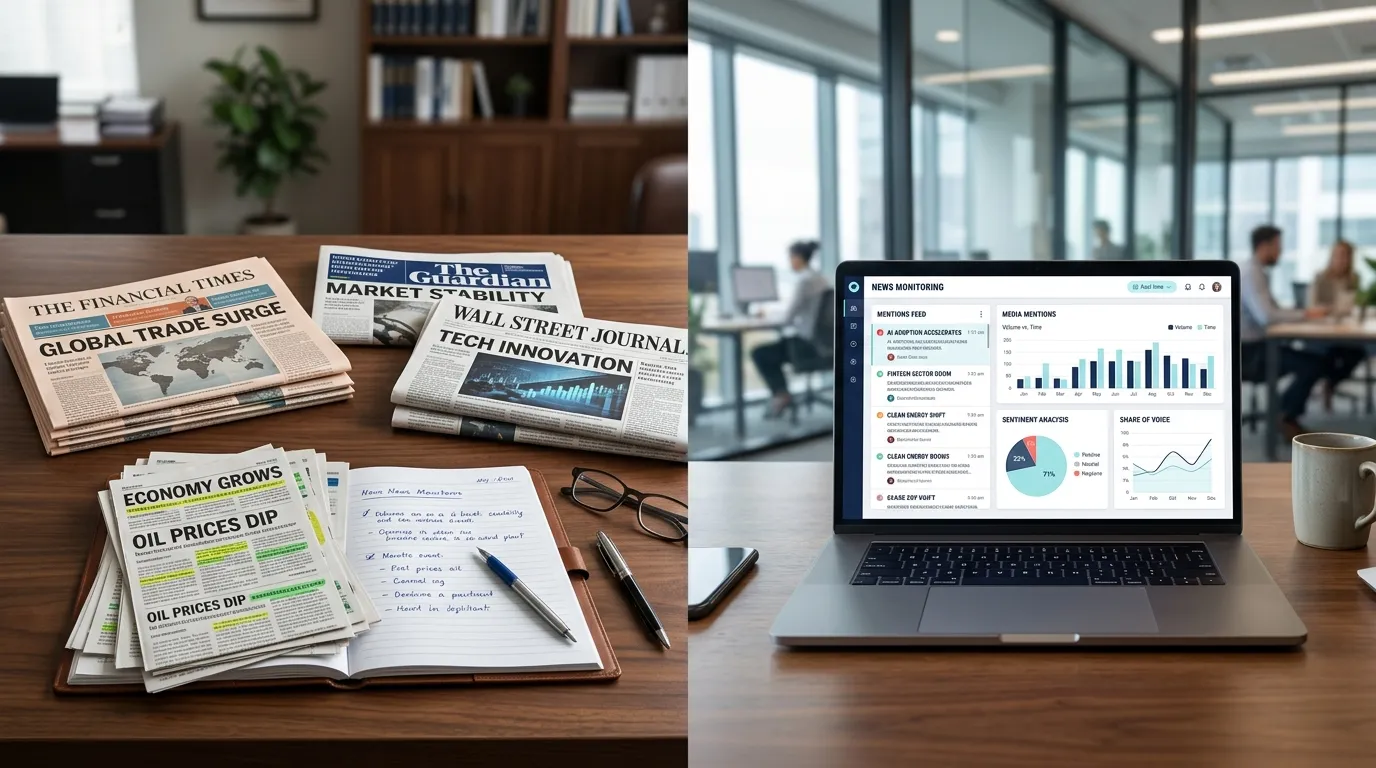
Neither column wins on every row. That is the point. Print gives you permanence and context. Online gives you speed and reach. The best setup depends on what you need to do with the information.
Why Print Still Matters
It is easy to say print is dying. It is harder to find a ministry, a bank board or a large listed company that has stopped caring what the papers say. Here is why newspaper monitoring services still earn their place.
A fixed, dated record. A printed story cannot be quietly changed next week. If a dispute comes up, the clipping settles what was actually published.
Measurable prominence. You can show your leadership that a story ran on the front page, took up a third of the page and carried a photo. That is a clear, simple measure of attention.
Weight with certain readers. Many senior managers, officials and policy makers still read the papers closely. A story there can shape a meeting even if it never trends online.
Regional and local language reach. Smaller papers publish stories about local issues, local branches and local leaders that national portals may skip. If you only watch the big websites, you can miss them.
Long life in archives. Print coverage sits in libraries and archives for years. Journalists, researchers and lawyers go back to it. Your own team may need it again in five years.
Why Online News Cannot Be Ignored
Now the other side. If you only read print, you will always hear about problems a day late.
Speed. An online story can be live within minutes. A negative piece posted in the evening is already circulating when the morning papers arrive.
Reach. One article can be opened by thousands of people and shared again and again. Print readers are limited by circulation. Online readers are limited only by how often the link is shared.
Early warning. Many stories start online and reach print the next day. If you see them early, you have a whole day to prepare a reply before the papers carry them.
Edits and updates. Because online stories keep changing, you need someone watching them as they change. A story can go from neutral to damaging after one update.
Link to social media. News portals feed social platforms, and social platforms feed news portals. Online news monitoring is often the first step in understanding how a story is spreading.
Where the Two Overlap
Most big stories appear in both places. A portal publishes in the evening, and the same story, often edited, appears in print the next morning. This overlap creates two problems that careless reports ignore.
Double counting. If you count the online version and the print version as two separate stories, your coverage numbers look bigger than they are. A good report links both versions to one story, so your leadership sees the real picture.
Different versions. The print edition and the online edition can differ in length, headline and even tone. Do not assume one is a copy of the other. Check both.
A monitoring team that handles both channels together can tag these as one story with two appearances. That keeps your data clean.
Which One Do You Need?
The honest answer is that it depends on your risk, your audience and what you use the coverage for. Here is how it usually looks.
Banks and Financial Institutions
Online news first, because false rumours about a bank spread quickly and need a fast reply. Print second, because regulators, boards and large clients often look at the papers, and you will want a formal record.
Telecom Companies
Online news is the priority. Outages, billing disputes and data complaints go viral fast. Print matters for follow up coverage, advertising checks and regional stories.
Government Organisations and NGOs
Both. Public bodies need a formal record of how policies were reported, and print gives that. Online coverage shows how the public is reacting right now. Regional papers also tell you how projects are seen outside the capital.
Listed Companies and Multinationals
Both. Online news can move sentiment and share prices within hours. Print gives investor relations and compliance teams a clean record for reports and audits.
FMCG and Consumer Brands
Online for launches, complaints and reviews. Print for ad tracking, competitor campaigns and coverage in local markets.
Crisis Management Teams
Online first, always, because speed is everything. Print follows, and it tells you which stories have reached a wider and more formal audience.

Why Most Organisations End Up Needing Both
If your budget forces a choice, start with the channel closest to your biggest risk. But in practice, most organisations that try one channel add the other within a few months.
Teams that only watch online news miss the print record, the front page placement and the regional stories. Teams that only watch print hear about trouble a day late and cannot respond in the first hours.
Watching both gives you three things:
- Speed from online, so you can react early
- Weight from print, so you can measure how serious the story became
- One clean record, so your reports show each story once and in full
How Ryans Archives Handles Print and Online Together
Ryans Archives Limited has provided media intelligence since 2000. Our team captures and analyses coverage across print, online news, TV, radio and social media, and combines AI assisted analysis with human quality checks on every deliverable.
Print and Online in One Report
Our News Coverage & Insights service tracks newspapers, online portals and broadcast news across Bangladesh. You get one set of briefs, not two, so a story that ran online and in print appears once with both appearances attached.
Priority Alerts and Scheduled Briefs
Priority and crisis level mentions are pushed to you in near real time, typically within minutes of publication or broadcast. Everything else arrives on the schedule you choose: hourly, daily or weekly.
Bangla and English
We monitor Bangla and English natively and support other languages on request. If you need summaries or transcripts, our Synopsis, Translation & Transcription service handles that.
Sentiment and Competitor Benchmarking
Every mention is scored for tone using a mix of AI classification and human review. We compare your coverage with the competitors you name, so you can see where you stand.
Reports in Your Format
Reports come as email alerts, Excel, Google Sheets, Word, Google Docs, PDF, PowerPoint, Google Slides, live dashboards and more. You choose the format and the schedule.
A Searchable Archive
Past coverage should not disappear into a folder. Our Historical Data & Digital Archiving service builds searchable archives, so you can find a story from years ago in seconds.
Who We Work With
Organisations across banking, telecom, energy, development, electronics and government use our services. Clients who have shared reviews on our website include Chevron Bangladesh, Banglalink, IFIC Bank, BRAC, Singer Bangladesh and Walton Hi Tech Industries.
Talk to our team about newspaper monitoring services
How to Choose a Monitoring Provider
Whichever provider you consider, ask these questions. The answers show the real difference.
- Do you cover both print and online, and do you combine them in one report? Ask how duplicates are handled.
- Which newspapers and portals do you track? Ask for a sample list, including regional and local language papers.
- Do I get the original clipping image and the placement details? Page, section and size should be included.
- Do you save a timestamped copy of online stories? This protects you if a story is edited or removed.
- How fast are alerts? Ask for typical delays, not the best case.
- Who reads the coverage? Software alone misses context, so ask how humans check the results.
- Can I choose the report format and schedule? Your board, your PR team and your compliance team need different views.
- Can you show real examples? Ask for sample reports and references from similar organisations.
Ask for a demo, and judge it using a real topic from your own business.
Common Mistakes to Avoid
Choosing on price alone. The cheapest service often skips human checks, regional papers or placement details, and you only notice when something goes wrong.
Counting one story twice. Online and print versions of the same story should be linked, or your numbers will mislead your leadership.
Reading only the headline. A neutral headline can sit on top of a damaging article. Read the story and check the tone.
Forgetting regional and local language papers. Problems often begin in a local paper and spread upward.
Not saving online stories. If a portal edits or deletes a story, you will have nothing to show unless you saved a copy.
Never reviewing your keywords. Your products, people and competitors change. Review your keyword list every quarter.

A Simple Way to Start
You do not need a long project. Four steps are enough.
- Decide the purpose. Are you protecting reputation, preparing for crises, tracking competitors or keeping records for compliance? Write down your top three goals.
- List your keywords. Include your brand, spelling variations, Bangla names, products, leaders, competitors and risk words such as recall, fraud, outage or lawsuit.
- Choose the mix. If speed is your biggest need, start with online and add print. If records and formal reporting come first, start with print and add online.
- Set the rhythm. Decide who gets priority alerts and who gets the daily or weekly brief, then review the results after the first month.
With Ryans Archives, you share your brand name, competitor list, target markets and preferred schedule. We reply within one business day with a scoped proposal, and most clients start receiving reports within about a week.
FAQs
What are newspaper monitoring services?
They are services that read printed newspapers and magazines every day, find stories about your organisation, and send them to you as clippings with details such as the paper, date, page and tone.
What is online news monitoring?
It is the tracking of news portals, digital newspaper editions, blogs and other online sources as stories go live, using software and human review to find and check mentions.
What is the main difference between newspaper monitoring and online news monitoring?
Speed and permanence. Online monitoring is faster and shows stories as they appear. Print monitoring gives you a fixed, dated record with measurable placement.
Do I need both?
Most organisations do. Online gives early warning, and print gives a formal record and regional reach. If you must start with one, choose the channel closest to your biggest risk.
Does Ryans Archives cover Bangla newspapers?
Yes. We monitor Bangla and English natively and support other languages on request.
How fast are alerts?
Priority and crisis level mentions are pushed in near real time, typically within minutes of publication or broadcast. Other coverage arrives hourly, daily or weekly.
What formats do reports come in?
Email alerts, Excel, Google Sheets, Word, Google Docs, PDF, PowerPoint, Google Slides, live dashboards and more.
How do I get started?
Send us your brand name, competitor list, target markets and reporting schedule through our contact page. You can also call +88 01755 513 979 or email archives@ryans.com.
Conclusion
Newspaper monitoring and online news monitoring do different jobs. Online tells you what is happening right now. Print tells you what became official, how prominent it was and what the record will show later. One without the other leaves a gap.
Start with your biggest risk, choose your keywords with care, and make sure a real person checks what the software finds. Then keep both channels in one clean report, so your team spends its time on decisions and not on sorting clippings.
Ryans Archives has been doing this since 2000. If you want to see how print and online coverage of your organisation looks in one report, request a demo and we will show you.