

How Sentiment Analysis Works in Media Monitoring
Every day, your organisation appears in news stories, TV segments and social posts. Some are warm, some are angry, and many are neutral. Counting them is easy. Understanding how people feel about you is much harder.
That is the job of sentiment analysis services. They read each mention and judge its tone, so you can see at a glance whether the mood around your brand is improving or getting worse. When it is done well, it becomes a core part of media intelligence: the practice of turning raw coverage into facts you can use to make decisions.
This guide explains what sentiment analysis is, how it works, where it goes wrong and how to read the numbers without being misled. We will also show how Ryans Archives Limited combines AI with human review to deliver reliable sentiment results for clients in Bangladesh and abroad.
What Is Sentiment Analysis in Media Monitoring?
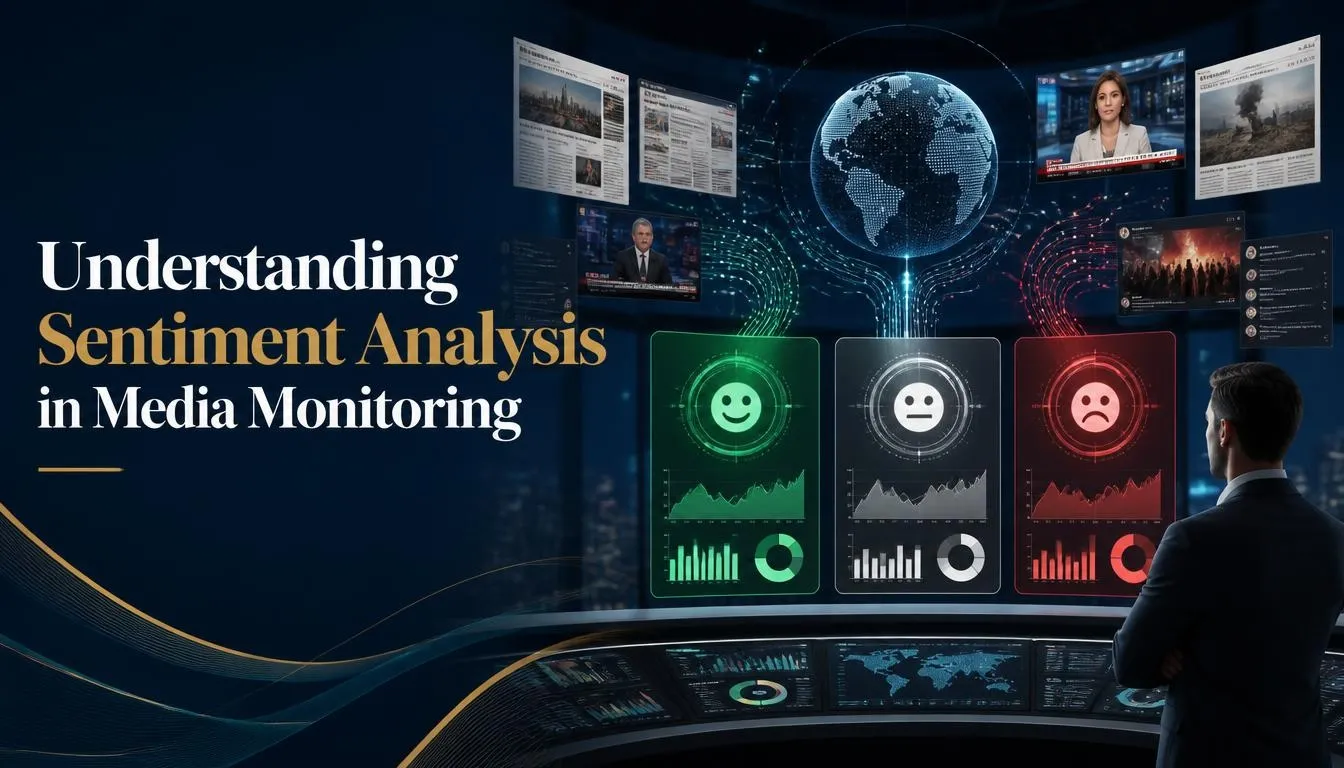
Sentiment analysis is the process of judging the tone of a piece of content. In media monitoring, it means reading each news story, broadcast clip or social post that mentions your organisation and labelling how it feels toward you.
The result gives you something a simple mention count never can. Fifty mentions in a week could be great news or a disaster, depending on what they say. Tone tells you which one it is.
Positive, Neutral, Negative and Mixed
Most services sort mentions into three groups:
- Positive: praise, good results, supportive quotes, awards or successful launches
- Neutral: facts and announcements without a clear opinion, such as a plain report of a board meeting
- Negative: criticism, complaints, scandals, failures or warnings
Some systems add a fourth group called mixed, for stories that praise one thing and criticise another. A review that loves your product but hates your delivery service is a good example.
Many tools also give a score, such as a number on a scale from very negative to very positive. A score looks precise, but it is still an estimate, and we will return to that point later.
Tone Toward You, Not Just the Story
This is the most misunderstood part. A story can be negative in general and still not be negative about you.
Imagine a news report about a fraud attack on a city. Your bank is mentioned as the one that caught it and protected its customers. The story is sad, but it is good for you. A basic tool might mark the whole article as negative because of the word fraud. A better one looks at the sentence about your bank and marks it as positive.
Good sentiment analysis therefore measures tone toward your specific name, product or person. This is sometimes called entity level sentiment, and it is one of the main differences between a basic tool and a trustworthy service.
How Sentiment Analysis Works
You do not need to be a data scientist to understand the basics. There are three layers in most modern services.
Rule Based Methods
The oldest approach uses word lists. Words such as excellent, trusted and success count as positive. Words such as fraud, failure and complaint count as negative. The software adds them up and decides.
This is fast and simple, but it struggles with context. The phrase "not bad" contains a negative word and means something positive. The phrase "the bank beat the fraud attempt" contains fraud and means good news.
Machine Learning and Language Models
Newer systems learn from examples. Thousands of sentences are labelled by people as positive, neutral or negative, and the software learns the patterns. Large language models go further and read whole sentences and paragraphs, which helps them handle negation and some indirect meaning.
These methods are far better than word lists, but they are only as good as the examples they learned from. A model trained mostly on English product reviews may perform poorly on Bangla news about a government project.
Human Review
The final layer is people. Trained analysts check a sample or all of the results, correct mistakes and handle the cases software finds hard. This layer is what makes the difference between a number you can show your board and a number you hope is right.
Why Sentiment Analysis Matters for Organisations
Counting coverage tells you how loud you are. Sentiment tells you how you are being received. Here is how organisations use it.
Spot a Crisis Early
A sudden rise in negative mentions is often the first sign of trouble. You may see it before any single story looks serious. If negative tone jumps from ten percent of mentions to forty percent in one afternoon, something has happened, and your crisis team should know about it quickly.
Measure Campaigns Honestly
A campaign can get plenty of coverage and still do damage. Sentiment shows whether the attention was welcome. It also shows which messages and spokespeople bring positive responses and which ones attract criticism.
Compare With Competitors
Tone looks different when you place it next to a rival. If your coverage is mostly neutral and a competitor gets steady praise, that is a gap worth understanding. Comparing share of voice and tone side by side helps marketing and PR teams decide where to put their effort.
Guide Spokesperson and Message Choices
Sentiment can show which topics lead to warm coverage and which ones lead to hard questions. Over time, you learn which leaders connect well with the press and which messages need to be reworked.
Report to Boards With Evidence
Leaders do not want a pile of clippings. They want to know whether things are getting better. A simple chart of tone over time, with a few example stories, answers that question in a minute.

Where Sentiment Analysis Goes Wrong
No honest provider will tell you that sentiment analysis is perfect. These are the common problem areas.
Sarcasm and irony. "Great job, as always" can be praise or a sharp insult. Software often reads the words and misses the tone.
Headlines versus body text. A scary headline can sit above a balanced article, or a calm headline can hide a damaging paragraph. Tools that look only at the headline get it wrong.
Mixed tone. One article can praise your product and criticise your pricing. Forcing it into a single label hides useful detail.
Negation. Phrases such as "not a failure" or "hardly a success" confuse weaker tools.
Neutral overload. Most news is factual, so a large share of mentions will be neutral. That is normal, but it can make charts look flat.
Name confusion. If your brand name is also a common word, mentions about something else get mixed into your results.
Source weight. A single post from a small account and a front page story in a national paper are not equal. A simple count treats them the same unless the service adds weight for reach and placement.
Why Bangla and Local Language Need Extra Care
If your audience speaks Bangla, this section matters for you. Many sentiment tools were built first for English. When they handle other languages, they often translate the text into English and then judge the tone. That adds mistakes at both steps.
Bangla adds its own challenges. There are regional dialects, many spelling variations, and a very common habit of writing Bangla in English letters on social media. Idioms and humour carry meaning that a literal translation loses.
The best approach is a service that reads Bangla natively and has Bangla speaking analysts reviewing the results. If a provider cannot show you how they handle Bangla, treat their Bangla sentiment numbers with care.
How to Read Sentiment Numbers Without Being Misled
Even good data can be misread. A few simple habits help.
Look at the trend, not one day. A single bad day can be noise. A steady slide over four weeks is a signal.
Check volume next to tone. Ninety percent positive sounds great, but not if it is based on ten mentions. Always check how many mentions sit behind the percentage.
Use net sentiment. This is the share of positive mentions minus the share of negative ones. For example, if 100 mentions include 40 positive, 50 neutral and 10 negative, your net sentiment is plus 30 points. It is a quick way to compare periods or competitors. This is an illustration, not real client data.
Read a sample. Pick ten stories behind any chart and read them. If the labels look wrong, ask your provider to review the settings.
Remember the audience. A story that pleases investors may upset customers. Ask who the tone is good or bad for.
Who Benefits Most From Sentiment Analysis Services
Corporate communication and PR teams. You get proof of how campaigns and statements landed, and early warning when the mood turns.
Brand and marketing teams. You can see how people talk about products, launches and advertising, and compare it with competitors.
Banks and financial institutions. Trust is fragile, and a shift in tone can show up before a rumour becomes a run on confidence. Sentiment gives your team a quick read on the mood.
Listed companies and multinationals. Investors and regulators read the same news you do. Tracking tone across countries and languages keeps your leadership informed.
Government bodies and NGOs. You can see how policies, projects and statements are being received and where the public is concerned or confused.
Crisis management teams. Tone shifts help you decide when a small issue has become a real problem.
How Ryans Archives Delivers Sentiment Analysis Services
Ryans Archives Limited has provided media intelligence since 2000. Our team captures and analyses coverage across print, online news, TV, radio and social media, and we combine AI assisted analysis with human quality checks on every deliverable.
AI Speed With Human Judgment
Every mention is scored for tone using a mix of AI classification and human review. The software handles the volume. Our analysts handle the hard cases, such as sarcasm, mixed tone and local expressions, so the final result is one you can trust.
Competitor and Topic Benchmarking
We benchmark share of voice, tone and topics against the competitors you name during onboarding. You can see where you lead, where you trail and which topics drive the difference.
Bangla and English
We monitor Bangla and English natively and support other languages on request. If you need summaries or transcripts of TV and radio content, our Synopsis, Translation & Transcription service can help.
News and Social Coverage
Our News Coverage & Insights service tracks print, broadcast and online news across Bangladesh. Our Social Media Listening service follows brand, competitor and industry conversations, so the tone you see covers both news and public discussion.
Priority Alerts
Priority and crisis level mentions are pushed to you in near real time, typically within minutes of publication or broadcast. Routine coverage arrives on the schedule you choose: hourly, daily or weekly.
Proof of Campaign Results
Our PR Campaign Performance service measures the real reach and impact of campaigns against your goals, with tone included. Our Advertisement Tracking service checks where and when your ads ran.
Reports in Your Format
Reports come as email alerts, Excel, Google Sheets, Word, Google Docs, PDF, PowerPoint, Google Slides, live dashboards and more. You choose the format and the schedule.
A Searchable Archive
Tone changes over months and years. Our Historical Data & Digital Archiving service builds searchable archives, so you can look back and compare today with last year.
Who We Work With
Organisations across banking, telecom, energy, development, electronics and government use our services. Clients who have shared reviews on our website include Chevron Bangladesh, Banglalink, IFIC Bank, BRAC, Singer Bangladesh and Walton Hi Tech Industries.
Talk to our team about sentiment analysis services
How to Choose a Sentiment Analysis Provider
Many vendors promise accurate sentiment. These questions help you check.
- Do humans review the results? Ask who checks the scores and how often.
- Is tone measured toward my brand or toward the whole story? Entity level analysis is the safer choice.
- How do you handle Bangla and mixed language posts? Ask for a live example.
- Can I see the original story behind every score? You should always be able to check the source.
- How do you treat mixed tone and sarcasm? Their answer shows how seriously they take quality.
- Do you weight mentions by reach and placement? A front page story should count for more than a minor post.
- Can I test it on my own topics? Ask for a trial with real keywords from your business.
- Can I choose the report format and schedule? Your board, PR team and compliance team need different views.
Ask for a demo, and judge it on a real topic from your own work.
Common Mistakes to Avoid
Treating the score as a fact. It is an estimate. Always read a sample of stories.
Looking at percentages without volume. Ninety percent of ten mentions means very little.
Judging a single day. Watch trends over weeks and months.
Ignoring neutral coverage. Neutral is often the largest group, and it shows what the press says without opinion.
Using an English only tool for Bangla content. You will miss meaning and get wrong scores.
Not acting on the data. A tone report that nobody reads changes nothing. Link it to your alert and response plan.
A Simple Way to Start
You do not need a long project. Four steps are enough.
- Decide what you want to know. Are you watching reputation, a campaign, a competitor or a crisis risk? Pick your top three questions.
- List your keywords. Include your brand, spelling variations, Bangla names, products, leaders, competitors and risk words.
- Set a baseline. Run the service for a few weeks to learn what normal looks like for your organisation.
- Review monthly. Compare tone with the baseline, read sample stories, and adjust your keywords and alerts.
With Ryans Archives, you share your brand name, competitor list, target markets and preferred schedule. We reply within one business day with a scoped proposal, and most clients start receiving reports within about a week.
FAQs
What are sentiment analysis services?
They are services that read news and social media mentions of your organisation and judge their tone as positive, neutral or negative, so you can track how people feel about you.
How does sentiment analysis fit into media intelligence?
Media intelligence turns coverage into useful insight. Sentiment analysis adds the tone layer, which shows whether coverage helps or hurts you, not just how much of it there is.
How accurate is sentiment analysis?
It varies by tool, topic and language. It is a useful guide, not a perfect measure, which is why human review matters, especially for Bangla content and sarcasm.
Can sentiment analysis read Bangla?
Some tools can, but quality varies a lot. At Ryans Archives, we monitor Bangla and English natively and combine AI classification with human review.
What is net sentiment?
It is the share of positive mentions minus the share of negative mentions. It gives you a single number for comparing periods or competitors.
Does Ryans Archives use AI for sentiment?
Yes. We score every mention using a mix of AI classification and human review, and we apply human quality checks on every deliverable.
How fast do I get alerts about negative coverage?
Priority and crisis level mentions are pushed in near real time, typically within minutes of publication or broadcast. Other coverage arrives hourly, daily or weekly.
How do I get started?
Send us your brand name, competitor list, target markets and reporting schedule through our contact page. You can also call +88 01755 513 979 or email archives@ryans.com.
Final Thoughts
Sentiment analysis turns a pile of coverage into a clear picture of how people feel about you. It helps you catch problems early, judge campaigns fairly, compare yourself with rivals and show your leaders real evidence.
But the number is only as good as the method behind it. Look for a provider that measures tone toward your brand, handles Bangla properly, shows you the source behind every score and has real people checking the results. Treat the score as a guide, read the stories, and connect what you learn to a plan for action.
Ryans Archives has been turning coverage into insight since 2000. If you want to see what the tone around your organisation looks like right now, request a demo and we will show you.