

How Media Monitoring Helps During a Corporate Crisis
A single unverified post can reach thousands of people before your communications team even sees it. By the time someone forwards the screenshot internally, journalists may already be calling, and the story has a shape you didn't choose. This is why crisis monitoring services have become a core part of reputation management for organizations that can't afford to be surprised by their own headlines.
Crisis monitoring isn't about watching the news after something breaks. It's about catching the first signal — a spike in mentions, a shift in tone, a complaint gaining traction — while there's still time to shape the response. For communication managers, PR teams, and executives, that early window is often the difference between a contained issue and a full-blown reputational crisis.
This guide breaks down what crisis monitoring services actually do, why real-time visibility matters more than ever, and how to build a monitoring strategy that supports your broader reputation management goals.
What Is Crisis Monitoring?
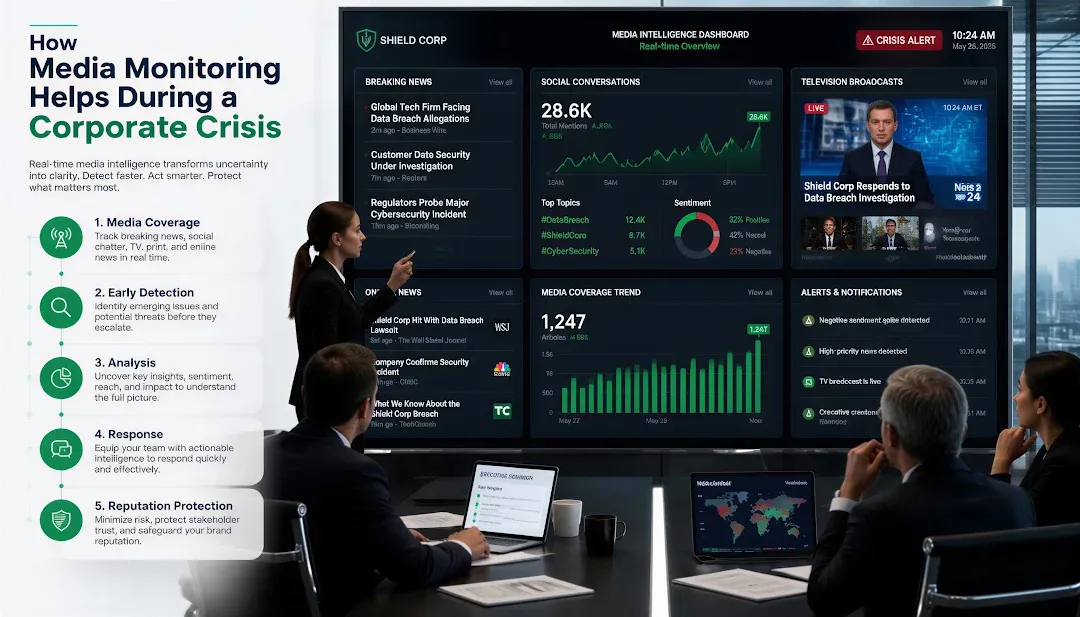
Crisis monitoring is the continuous tracking of news, social media, forums, and broadcast content to detect early signs of reputational risk before they escalate into a full crisis. It combines automated alerts, sentiment analysis, and human oversight to flag unusual spikes in mentions, negative coverage, or emerging narratives tied to a brand, executive, or industry.
Unlike a one-time media scan, crisis monitoring runs continuously — often 24/7 — because reputational threats don't wait for business hours. A product complaint posted at midnight can trend by morning. A regulatory rumor can spread across financial forums before a company's press office opens for the day. Crisis monitoring services exist to close that gap.
Crisis Monitoring vs. Everyday Media Monitoring
Routine media monitoring tracks general brand mentions, campaign performance, and industry news over time. It's useful for measuring PR impact and staying informed. Crisis monitoring is narrower and more urgent: it's tuned to detect anomalies — sudden volume spikes, sentiment drops, or the first mentions of a specific incident — and push that information to the right people immediately.
Think of everyday monitoring as a weather report and crisis monitoring as a storm alert. Both use similar tools, but the second is built for speed, escalation, and action.
Why Corporate Crises Escalate Without Real-Time Monitoring
Most reputational crises don't start as crises. They start as a single complaint, a leaked internal email, or a minor service failure. What turns them into full-blown emergencies is usually the same thing: nobody saw it coming until it was already trending.
Without real-time monitoring, communication teams typically find out about a brewing issue in one of two ways — a journalist calls for comment, or a senior executive forwards a screenshot with “have you seen this?” By that point, the narrative is already being shaped by people outside the organization. The company is reacting to a story instead of helping write it.
Delay compounds the damage in three specific ways. First, silence gets interpreted as guilt or indifference, even when the organization simply hasn't seen the issue yet. Second, competitors, activists, or opportunistic accounts can fill the information gap with their own framing. Third, once traditional media picks up a social media story, the original context is often lost, and corrections become much harder to issue credibly.
This is why crisis monitoring services matter so much: the cost of detecting an issue two hours late is not linear. A complaint that could have been resolved with a single reply at 9 a.m. can become a boycott hashtag by noon. Reputation management works best as prevention, not damage control.
Here's how that plays out in practice: a customer posts a video alleging a product defect. In the first hour, it reaches a few hundred people within their own network. Without monitoring, the brand has no visibility into this at all. By hour three, a local news account picks it up because it's generating engagement, and by hour six, it's been reframed as “company ignores safety complaint” — even if the original claim was inaccurate or already being investigated internally. Each stage the story passes through without a company response adds a layer of narrative that becomes harder to walk back. Real-time monitoring doesn't just save time; it preserves the organization's ability to be part of its own story from the very first hour.
How Crisis Monitoring Services Work
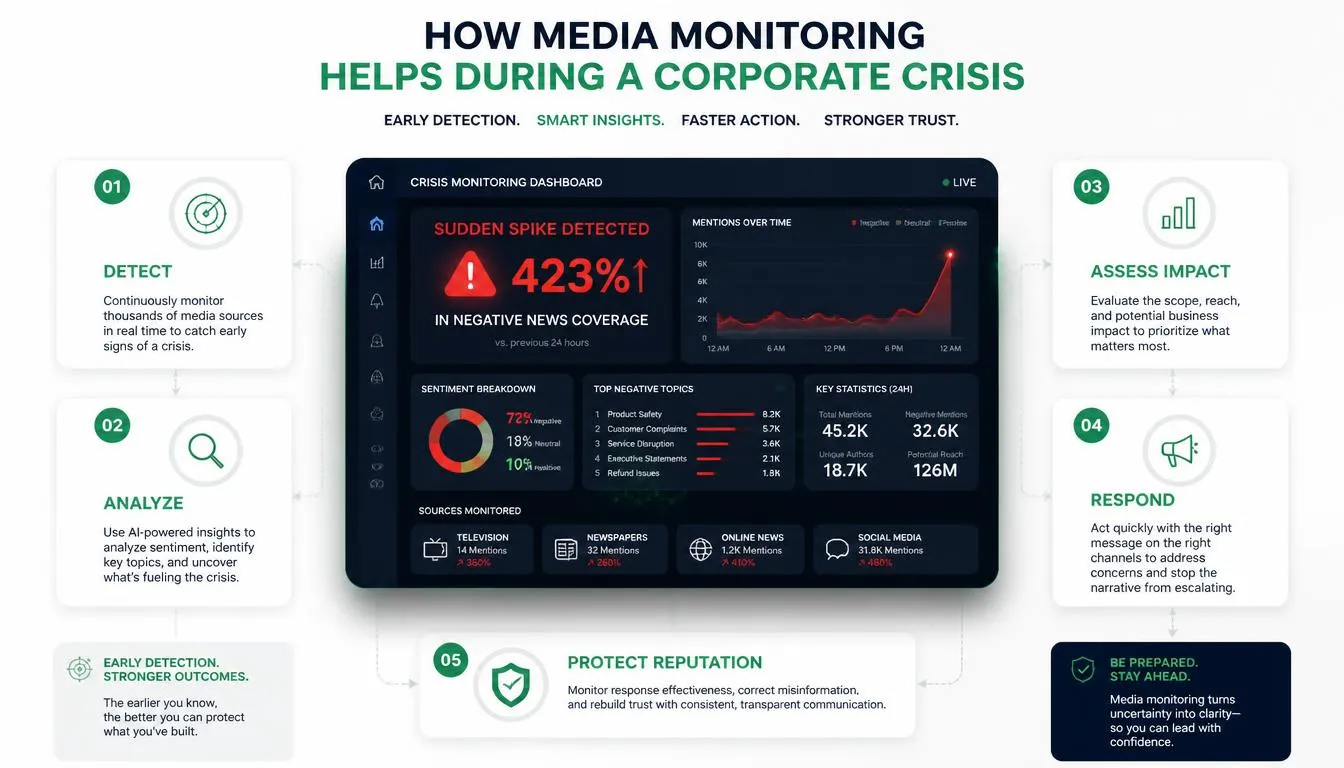
Crisis monitoring platforms combine automated technology with human analysts to track, interpret, and route information about emerging threats. While specific tools vary, most crisis monitoring services are built around four core capabilities.
Real-Time Alerts and Issue Detection
The system continuously scans for mentions of a brand, product, executive, or predefined keywords across thousands of sources. When mention volume, negative sentiment, or specific trigger terms cross a set threshold, the platform sends an immediate alert to the communication or crisis response team — often within minutes of the spike starting, not hours.
Sentiment Analysis and Tone Tracking
Volume alone doesn't tell the full story. A surge in mentions could be positive (a viral campaign) or negative (a scandal). Sentiment analysis classifies mentions as positive, negative, or neutral, and tracks how that balance shifts hour by hour, giving teams an early read on whether a story is turning against them.
Multi-Channel Coverage
A credible crisis monitoring service tracks more than Twitter/X and Facebook. It should cover national and local news outlets, broadcast transcripts, niche forums, review sites, regulatory filings, and messaging-app-adjacent public channels where rumors often start before they reach mainstream social media. Blind spots in coverage are blind spots in reputation management.
Coverage gaps are rarely obvious until they cost an organization time. A complaint that originates on a niche industry forum or a regional news site may sit unnoticed for days if a monitoring setup only tracks major social platforms and national press. By the time it surfaces on a mainstream feed, the story has already had time to gather momentum and commentary elsewhere, and the organization is playing catch-up on a narrative that's been forming for longer than it appears.
Share of Voice and Competitor Benchmarking
During a crisis, it matters not just what's being said about your brand, but how that compares to competitors and industry norms. Share-of-voice tracking helps teams gauge whether a story is uniquely damaging to them or part of a broader industry narrative — useful context when deciding how aggressively to respond.
Key Benefits of Crisis Monitoring for Reputation Management
The direct payoff of crisis monitoring is speed, but the downstream benefits touch nearly every part of reputation management.
Earlier detection means smaller crises. Catching an issue in its first hour, rather than its first day, dramatically increases the odds of containing it before it reaches mainstream media or regulators.
Better-informed leadership decisions. Executives making high-stakes calls about whether to issue a statement, involve legal counsel, or stay quiet need accurate, real-time data — not gut instinct or a single viral screenshot forwarded by a board member.
Stronger stakeholder confidence. Investors, regulators, and partners notice when a company responds quickly and accurately to a developing situation. Fast, informed responses signal operational maturity, which supports long-term reputation management beyond the immediate incident.
Protection against misinformation. Crisis monitoring surfaces false claims or manipulated content early, giving legal and communications teams time to issue corrections before misinformation is treated as fact.
Post-crisis learning. Monitoring data doesn't disappear once the crisis ends. It becomes a record teams can analyze to understand what triggered the spread, which channels amplified it, and how the response performed — valuable input for refining the crisis communication plan.
A defensible record for legal and compliance. In regulated industries, being able to show exactly when an issue was first detected, what data informed the response, and how quickly action was taken can matter as much to regulators and auditors as it does to the public. Crisis monitoring logs provide a timestamped record that supports this kind of accountability, which is difficult to reconstruct after the fact from memory or scattered screenshots.
These benefits are why crisis monitoring has moved from a specialist PR tool to a standard line item in enterprise risk management. It sits at the intersection of communications, legal, and operations — which is exactly where most modern reputational threats originate.
Crisis Monitoring Needs by Industry
Crisis monitoring priorities shift depending on what's actually at stake for an organization.
Banks and Financial Institutions
For banks, unmonitored rumors about solvency, fraud, or data breaches can trigger real financial consequences, including deposit runs. Regulatory and compliance risk make round-the-clock monitoring of financial forums and news outlets a near-necessity rather than a nice-to-have.
Telecom Companies
Service outages, data privacy incidents, and billing disputes generate high mention volumes quickly for telecom providers, given how directly and frequently customers interact with the service. Real-time monitoring helps distinguish a localized complaint from a network-wide failure gaining public attention.
Government and NGOs
Public sector bodies and NGOs face a different challenge: misinformation and politically motivated narratives that can spread faster than official channels can respond. Monitoring here supports not just reputation but public trust and, in some cases, public safety during emergencies.
Publicly Listed and Multinational Companies
For publicly listed and multinational companies, a reputational crisis in one market can affect stock price, investor confidence, and operations in unrelated regions. Cross-market, multilingual monitoring becomes essential to catch region-specific issues before they escalate globally.
Building a Crisis Monitoring Strategy: A Step-by-Step Framework
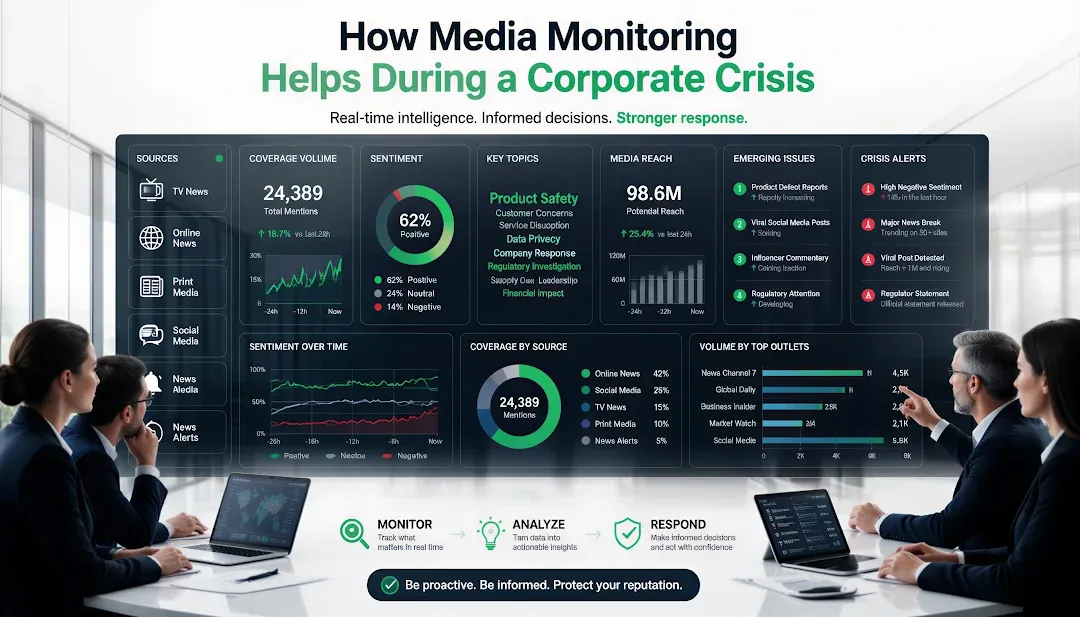
A monitoring tool alone doesn't prevent a crisis — the strategy around it does. The following framework outlines how communication and risk teams typically structure an effective approach.
1. Define your risk triggers in advance. Before a crisis happens, identify the keywords, executives, products, and scenarios that matter most to your organization. This might include your brand name, common misspellings, executive names, product lines, and known sensitive topics.
2. Set alert thresholds and escalation paths. Decide in advance what volume or sentiment shift qualifies as “notify the team” versus “escalate to leadership immediately.” Without this, teams either get alert fatigue from too many notifications or miss real signals buried in noise.
3. Assign clear ownership. Every alert needs an owner who reviews it, verifies context, and decides on next steps. Ambiguity about who's responsible for monitoring on nights and weekends is one of the most common reasons early warnings get missed.
4. Integrate monitoring with your crisis communication plan. Monitoring data should feed directly into pre-approved response templates, spokesperson protocols, and legal review processes, so the team isn't drafting a plan from scratch while a story is already spreading.
5. Run periodic drills. Treat crisis monitoring the way organizations treat fire drills — test the alert-to-response pipeline regularly so gaps are found during a rehearsal, not during an actual crisis.
6. Review and refine after every incident. After a crisis, however minor, review how quickly it was detected, how the team responded, and what the monitoring data revealed in hindsight. Each review should sharpen the keyword list and thresholds for next time.
7. Keep the plan visible to the people who need it. A crisis monitoring strategy that lives only in a slide deck from last year's planning session won't help anyone at 11 p.m. on a Friday. Store escalation contacts, alert thresholds, and response templates somewhere the on-call team can access instantly, and revisit the document on a fixed schedule — quarterly is common — so it doesn't quietly go out of date as staff, products, and risks change.
None of these steps require an unusually large team or budget. What they require is discipline: deciding the rules before there's pressure to make decisions quickly, and making sure the right people know their role without needing to be told during the incident itself.
Choosing the Right Crisis Monitoring Service Provider
Not all crisis monitoring services offer the same depth of coverage or responsiveness. Organizations evaluating providers should look past dashboard aesthetics and focus on operational substance.
Must-Have Features Checklist
- True 24/7 monitoring, not business-hours-only alerts, with human analyst backup for high-severity events
- Broad source coverage spanning news, social platforms, forums, broadcast, and regional/local outlets relevant to your markets
- Multilingual capability if the organization operates across regions
- Configurable alert thresholds to reduce noise while catching genuine spikes
- Sentiment and tone accuracy, ideally validated by human review rather than automated scoring alone
- Historical data and reporting for post-crisis analysis and board-level reporting
- Integration options with existing communication, CRM, or compliance workflows
- Clear escalation and support protocols, including a named contact during active incidents
Request a live demonstration using a real or simulated scenario relevant to your industry before committing. A provider's response speed and clarity during a demo crisis is often the clearest indicator of how they'll perform during a real one.
This is the checklist we built our own service around at Ryan's Archives. We work with corporate communication teams, banks, telecoms, government bodies, and multinational companies to provide round-the-clock crisis monitoring, backed by human analysts rather than automated alerts alone.
Frequently Asked Questions
What is the difference between crisis monitoring and reputation management?
Crisis monitoring is a tool and process for detecting reputational threats in real time. Reputation management is the broader discipline of shaping and protecting how an organization is perceived over time. Crisis monitoring feeds into reputation management by supplying the early-warning data that makes a fast, informed response possible.
How fast should a crisis monitoring alert reach the response team?
Ideally within minutes of a significant spike in volume or negative sentiment. Delays of several hours often mean the story has already moved from social media into traditional press coverage, which is much harder to redirect.
Do small and mid-sized organizations need crisis monitoring, or is it only for large enterprises?
Any organization with public-facing operations, employees, or customers can be affected by a reputational incident. Smaller organizations may need a lighter-weight setup, but the same idea holds either way: early detection reduces damage, regardless of size.
Can crisis monitoring prevent a crisis entirely?
Not always, but it significantly narrows the response window, which often determines whether an issue stays contained or escalates into sustained negative coverage. Prevention isn't guaranteed; faster, better-informed response is.
Should crisis monitoring be handled in-house or outsourced to a specialist provider?
It depends on scale and risk exposure. Organizations with dedicated communications staff and moderate risk may manage basic monitoring internally using off-the-shelf tools. Banks, telecoms, government bodies, and multinational companies typically benefit from a specialist provider that offers 24/7 human analyst coverage, broader multilingual source access, and established escalation protocols that internal teams would take significant time and budget to replicate on their own.
Make Monitoring Part of Your Crisis Readiness
A corporate crisis rarely announces itself politely. It usually starts as a small signal buried in thousands of daily mentions, and the organizations that come out of it with their reputation intact are almost always the ones that caught that signal early. Crisis monitoring services give communication, PR, and risk teams the visibility to act on facts instead of guesswork, and to shape the narrative instead of chasing it.
Reputation management isn't built during a crisis. It's built in the weeks and months of preparation beforehand, including the monitoring systems, escalation plans, and team ownership put in place while things are calm.
At Ryan's Archives, we provide crisis monitoring services built for exactly this kind of preparation — 24/7 alerts, multi-channel coverage, and a team that helps you act in the first hour, not the sixth. If your organization doesn't yet have real-time crisis monitoring in place, get in touch with Ryan's Archives and we'll help you set it up before you need it.