

10 Benefits of Real-Time News Monitoring for Businesses
A few years ago, a mid-sized consumer goods company found out about a supplier scandal from a customer’s angry tweet — three days after the story had already made national headlines. By the time their PR team caught up, competitors had already positioned themselves as the “responsible” alternative. That gap, those three days, cost them shelf space they never fully won back.
Stories like this play out constantly, in industries far beyond consumer goods. Markets move fast. Regulations shift overnight. A single news cycle can reshape customer sentiment before your morning coffee finishes brewing. This is exactly why more companies are turning to news monitoring services to keep pace — not because it’s trendy, but because the cost of missing something important keeps climbing.
The instinct to check the news once a day, or to rely on a few trade newsletters, made sense when news traveled slower. It doesn’t hold up anymore. A local supplier issue can become a national talking point within hours. A single influencer post can shift customer sentiment before your team even sits down for the weekly meeting. Businesses that still treat information gathering as a once-a-day task are, in effect, always operating on old data.
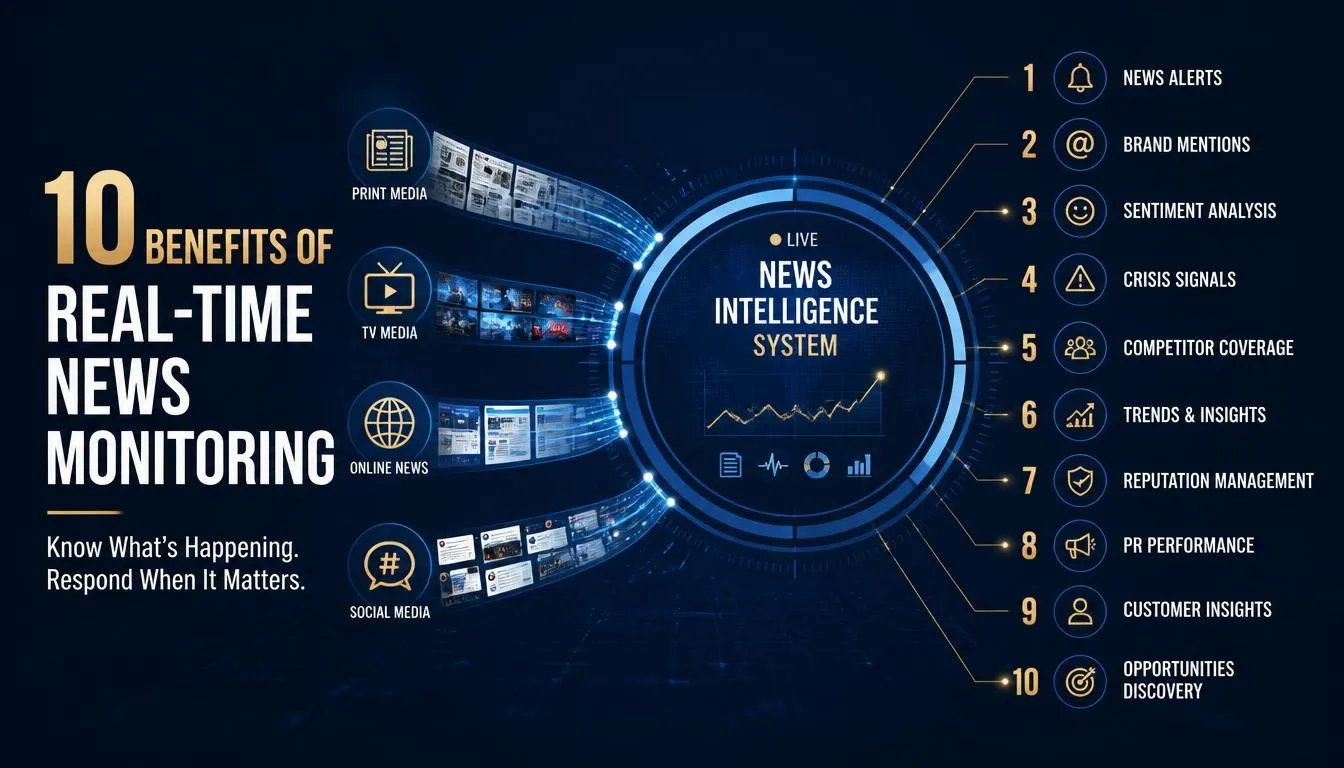
That’s not a knock on anyone’s diligence — it’s just a reflection of how much the information environment has changed. Below are ten concrete ways real-time news monitoring pays off for businesses, whether you’re running a five-person startup or overseeing a global brand.
1. You Catch Problems Before They Become Crises
Reputational damage rarely announces itself politely. It usually starts as a single complaint, a local news mention, or a niche forum thread — and then it snowballs.
With real-time monitoring in place, your team sees these early signals as they surface, not weeks later in a quarterly report. That head start is often the difference between a quiet correction and a full-blown PR emergency. Media alerts flagged the moment a story breaks give your communications team room to respond thoughtfully instead of scrambling defensively.
Why Timing Matters More Than Content
It’s not just what you say in a crisis — it’s when you say it. Companies that respond within hours of a story breaking are generally seen as more in control than those who wait for confirmation through slower internal channels.
Think about the last time a brand you followed went quiet during a controversy. Silence tends to read as either guilt or disorganization, even when neither is true. Teams with real-time monitoring in place have the advantage of knowing the moment a story starts gaining traction, which means the “we’re aware and looking into it” statement can go out fast, buying time for a fuller response later.
2. You Spot Competitive Moves as They Happen
Competitors don’t send memos before they launch a product, cut prices, or announce a partnership. They just do it, and the news usually breaks somewhere online before it hits your inbox through official channels.
Tracking mentions of competitor names, executives, and product lines means you’re not the last to know about a shakeup in your space. Sales teams especially benefit here — walking into a client meeting already aware that a rival just had a public stumble changes the entire conversation.
This kind of awareness also shapes longer-term strategy. If three competitors quietly pivot toward the same new market within a month of each other, that pattern tells you something about where demand is heading, even before formal industry reports catch up. Businesses that piece together these smaller signals over time often spot bigger shifts before their slower-moving rivals do.
3. You Make Faster, More Informed Decisions
Business decisions built on outdated information tend to age poorly. Whether you’re deciding on inventory levels, marketing spend, or expansion timing, having a live feed of relevant developments removes a lot of guesswork.
Executives who lean on real-time news monitoring aren’t just reacting faster — they’re deciding with more context. A supply chain disruption reported overnight in a manufacturing hub, for instance, might change a procurement decision that would otherwise have gone ahead blind.
From Reactive to Proactive
There’s a real difference between hearing about a shift after it’s already affected your quarter and hearing about it while there’s still time to adjust course. That gap is where good monitoring earns its keep.
This applies just as much to smaller, day-to-day calls as it does to major strategic pivots. A retail buyer who catches early news of a tariff change can adjust an order before pricing locks in. A hiring manager who sees layoff news at a nearby competitor might get ahead of a hiring surge instead of scrambling to compete for talent after everyone else has already noticed.
4. You Protect Your Brand’s Reputation Continuously
Brand reputation isn’t built once and left alone — it’s maintained daily, often in places you’re not directly watching. A negative review that goes viral, a misquote attributed to your CEO, or an old controversy resurfacing can all chip away at trust if left unaddressed.
Real-time monitoring acts like a smoke detector for your brand. It doesn’t stop the fire from starting, but it makes sure you’re not the last one to notice the smoke. Many companies pair monitoring with a lightweight response protocol, so when something needs a comment, someone’s already looped in.
It’s worth noting that most of what shows up in daily mentions isn’t dramatic — it’s routine chatter, minor mentions, the occasional customer complaint. The value isn’t in reacting to every single mention; it’s in having visibility so the rare moment that does matter doesn’t slip past unnoticed. That’s a subtle but important distinction between monitoring for the sake of it and monitoring with a clear purpose.
5. You Stay Ahead of Regulatory and Industry Shifts
Regulations change, sometimes with little warning, and industries built around finance, healthcare, or food safety live under constant scrutiny. Missing a policy announcement isn’t just inconvenient — it can mean falling out of compliance without realizing it.
News monitoring services that track regulatory bodies, industry associations, and relevant government agencies give compliance teams a practical early-warning system. Instead of learning about a new rule from a client’s question, your legal team already has the memo drafted.
This matters even for businesses that don’t operate in heavily regulated industries. Data privacy rules, labor law updates, and environmental reporting requirements have a way of touching companies that never expected to be affected. A furniture retailer might not think of itself as needing to track packaging regulations, until a new rule on materials disclosure lands with a compliance deadline attached.
6. You Identify New Business Opportunities Early
Not every alert is a warning — some are openings. A competitor exiting a market, a new government contract up for bid, or a shift in consumer sentiment toward sustainability can all represent genuine opportunity if you catch it in time.
Businesses that treat monitoring as purely defensive miss half its value. Teams that also use it offensively — scanning for openings, partnership signals, or underserved gaps — tend to move on opportunities while competitors are still reading the same headlines a day later.
Turning Alerts Into Action
The trick is having a process for what happens after an interesting alert comes in. A great signal caught by your monitoring tool is only useful if someone actually acts on it before the window closes. That might mean assigning a specific person to review flagged opportunities weekly, or building a quick internal channel where anyone can flag something worth a second look. Without that step, even the best monitoring setup just becomes noise nobody has time to sift through.
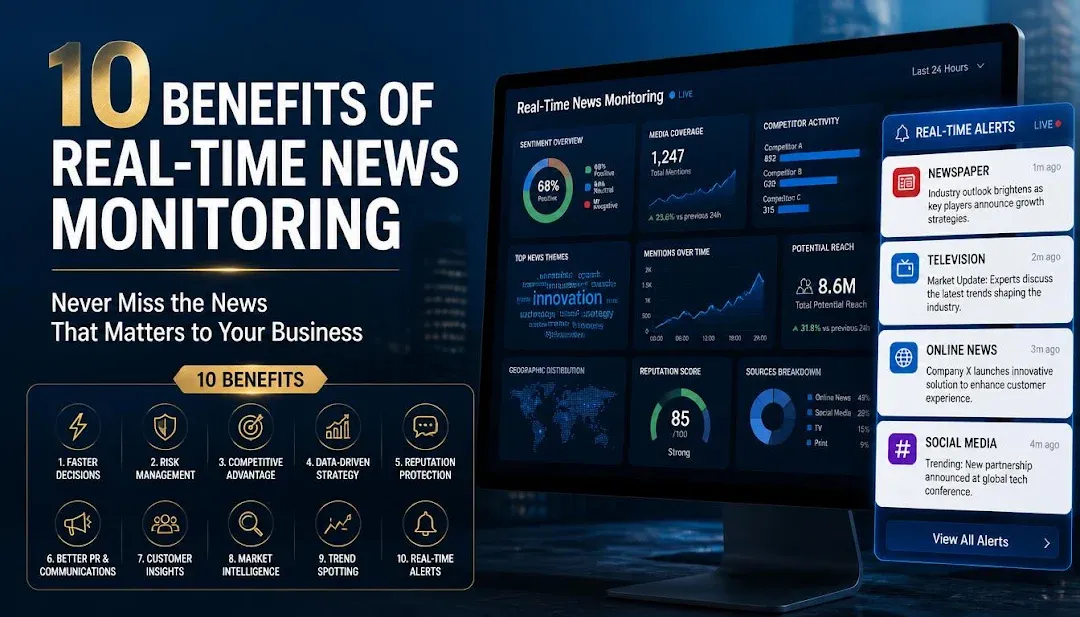
7. You Save Time Otherwise Spent Manually Searching
Before automated monitoring became common, someone on the team — often a junior marketer or an overworked founder — was manually checking news sites, setting up basic search alerts, and hoping nothing important slipped through. It was inefficient and inconsistent by design.
Automating this process frees up hours every week that were previously spent on repetitive searching. That time goes back into actual strategy, content, or client work instead of refreshing a browser tab hoping for updates.
There’s also a consistency problem with manual tracking that’s easy to overlook. People get busy, priorities shift, and the “quick daily check” quietly turns into a once-a-week habit, then stops altogether. A monitoring system doesn’t have that problem — it keeps working at the same pace whether the team is swamped or not, which means coverage doesn’t quietly degrade during your busiest weeks, which is exactly when you can least afford to miss something.
8. You Improve Investor and Stakeholder Communication
Investors and board members expect leadership to be aware of developments that could affect the business, and they notice when a company gets blindsided by news that was publicly available. Being caught off guard in a board meeting isn’t a great look, no matter how solid the underlying numbers are.
Real-time awareness lets leadership speak to relevant developments with confidence rather than playing catch-up. It also signals operational maturity — a business that’s watching its environment closely tends to inspire more confidence than one that isn’t.
For public companies especially, this extends to how quickly leadership can respond to analyst questions after a relevant news event. A CEO who can address a supply chain headline on an earnings call, rather than dodging around it, tends to come across as far more credible to the people evaluating whether to keep backing the business.
9. You Enable Smarter Crisis Communication Planning
Crisis plans that sit untouched in a shared drive rarely help when something actually goes wrong. What makes a difference is having live information feeding into that plan the moment it’s needed.
Media alerts tied directly into your crisis communication workflow mean the plan gets activated with real, current facts rather than assumptions made after the fact. Teams that combine monitoring with a rehearsed response process tend to handle real incidents with noticeably less internal chaos.
A crisis plan built around outdated assumptions can actually do more harm than having no plan at all, since it sends the team down a path that doesn’t match the current situation. Live monitoring keeps that plan grounded in what’s actually happening, not what someone guessed might happen when the document was written eighteen months ago.
10. You Build a Culture of Informed Decision-Making
Perhaps the most underrated benefit is cultural. When relevant news and industry shifts are visible across departments — not siloed with one communications person — teams start making decisions with a shared, current understanding of the landscape.
Marketing, sales, product, and leadership all benefit from working off the same real-time picture instead of fragmented, outdated impressions. Over time, this shifts how a company operates: less firefighting, more forward planning.
It also changes how meetings actually run. Instead of someone spending the first ten minutes catching everyone up on what happened this week, the team can start from a shared baseline and get straight to deciding what to do about it. That might sound like a small efficiency gain, but multiplied across every department meeting, every week, it adds up to a meaningfully different pace of operating.
Bringing It All Together
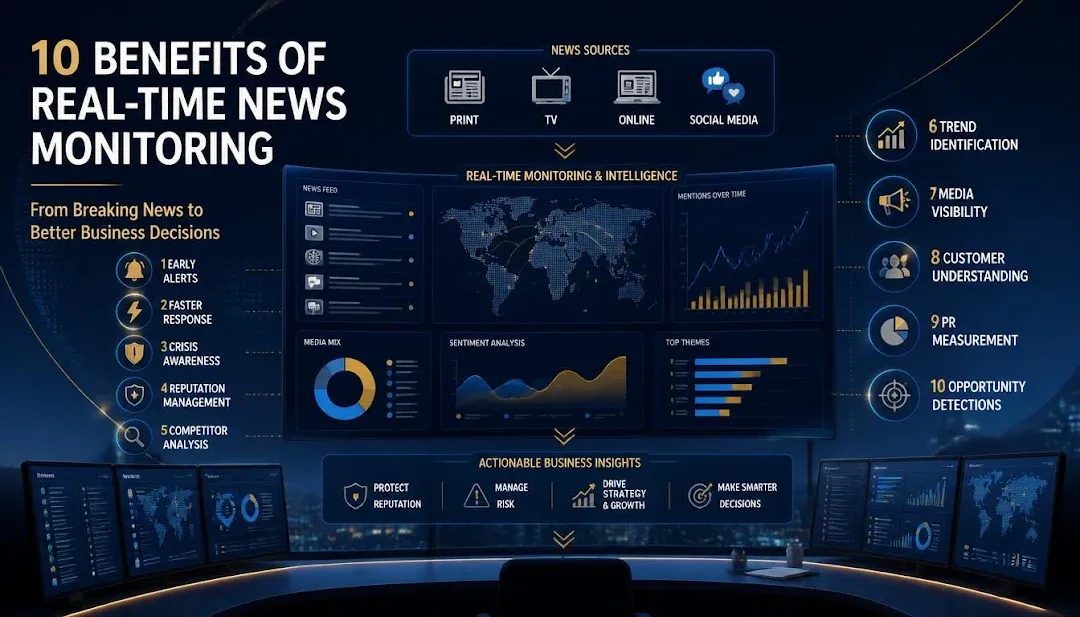
None of this requires turning your office into a 24-hour newsroom. It just means having the right systems in place so that important information reaches the right people quickly, instead of trickling in through secondhand channels or lucky timing.
Businesses that invest in solid news monitoring services tend to find the value shows up in small, steady ways — a crisis caught early, an opportunity spotted first, a board meeting where leadership actually knew what was going on. It’s rarely dramatic. It’s just consistently useful.
If you’re currently relying on manual searches or scattered alerts, it might be worth asking your team a simple question: how much would we have saved, or gained, if we’d known sooner? More often than not, the answer points toward building a more deliberate monitoring setup — one that actually keeps pace with how fast news moves today.
What’s been your experience — has a missed story ever cost your team more than it should have? It’s usually a good sign that it’s time to tighten things up.